The New Economics of FAST, AVOD and the Road to 2027
The streaming business has entered a new phase. Growth is no longer defined primarily by subscriber counts. In 2026, the industry is increasingly organized around advertising, live programming, smarter use of content libraries, better discovery, and the economics of keeping viewers engaged without continually increasing content spending.
For FAST channels, AVOD platforms, content owners and streaming operators, that shift is creating both opportunity and pressure. Audiences continue moving toward streaming, but simply launching another channel or accumulating another large catalog is no longer enough. The next competitive battleground is monetization: matching the right programming to the right audience, keeping channels fresh, improving advertising yield and extracting more value from content that has already been produced.
As 2027 approaches, the streaming market increasingly looks less like a collection of competing Netflix-style subscription services and more like a digital reinvention of television—one where subscription, free streaming, linear channels, on-demand libraries, live events, sports and advertising coexist within the same ecosystem.
Here are the trends defining that transition.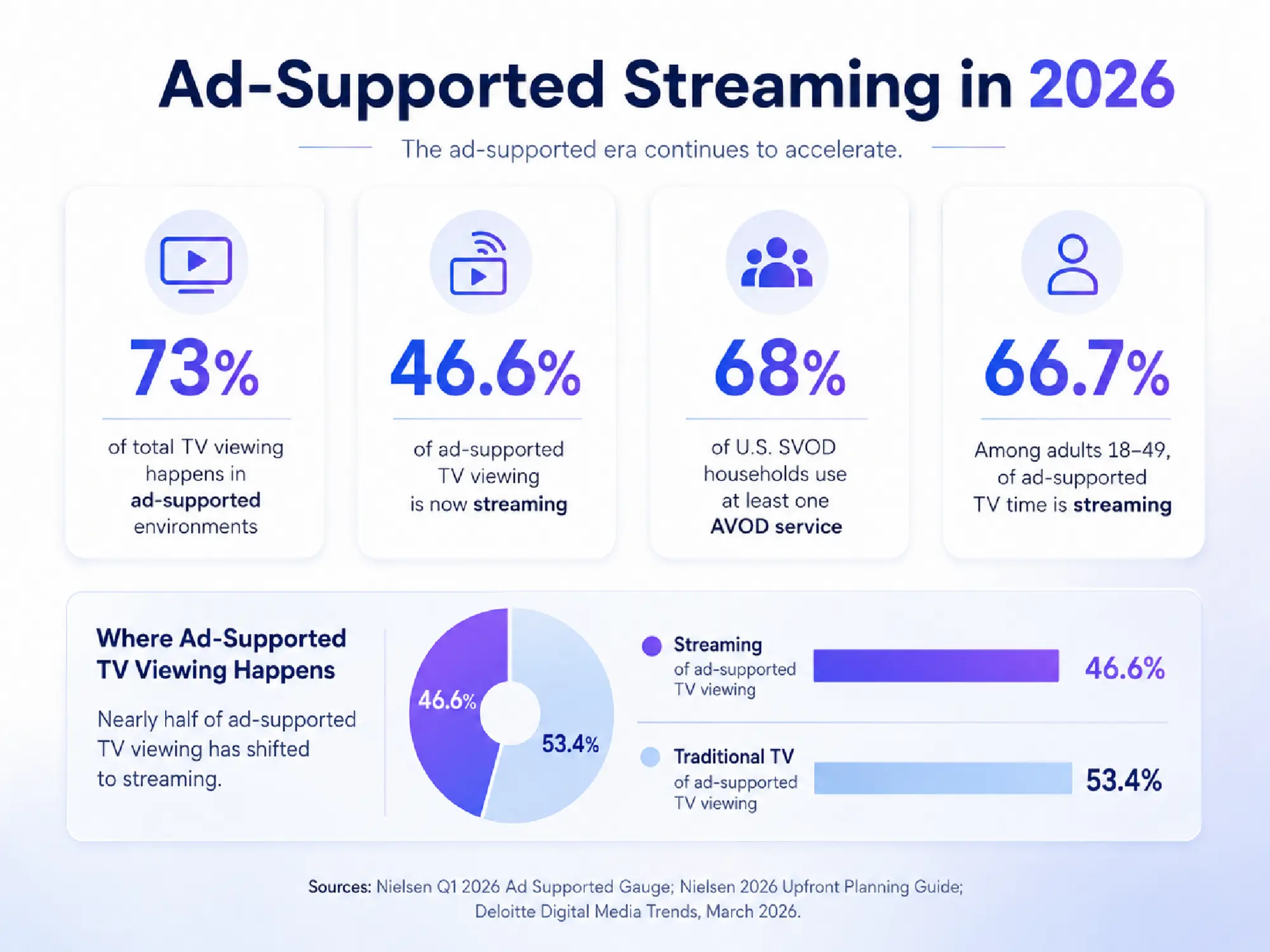
1. Ad-Supported Streaming Has Moved From Alternative to Mainstream
Perhaps the most important development of 2026 is that ad-supported streaming is no longer a secondary business model.
It is becoming the center of the streaming economy.
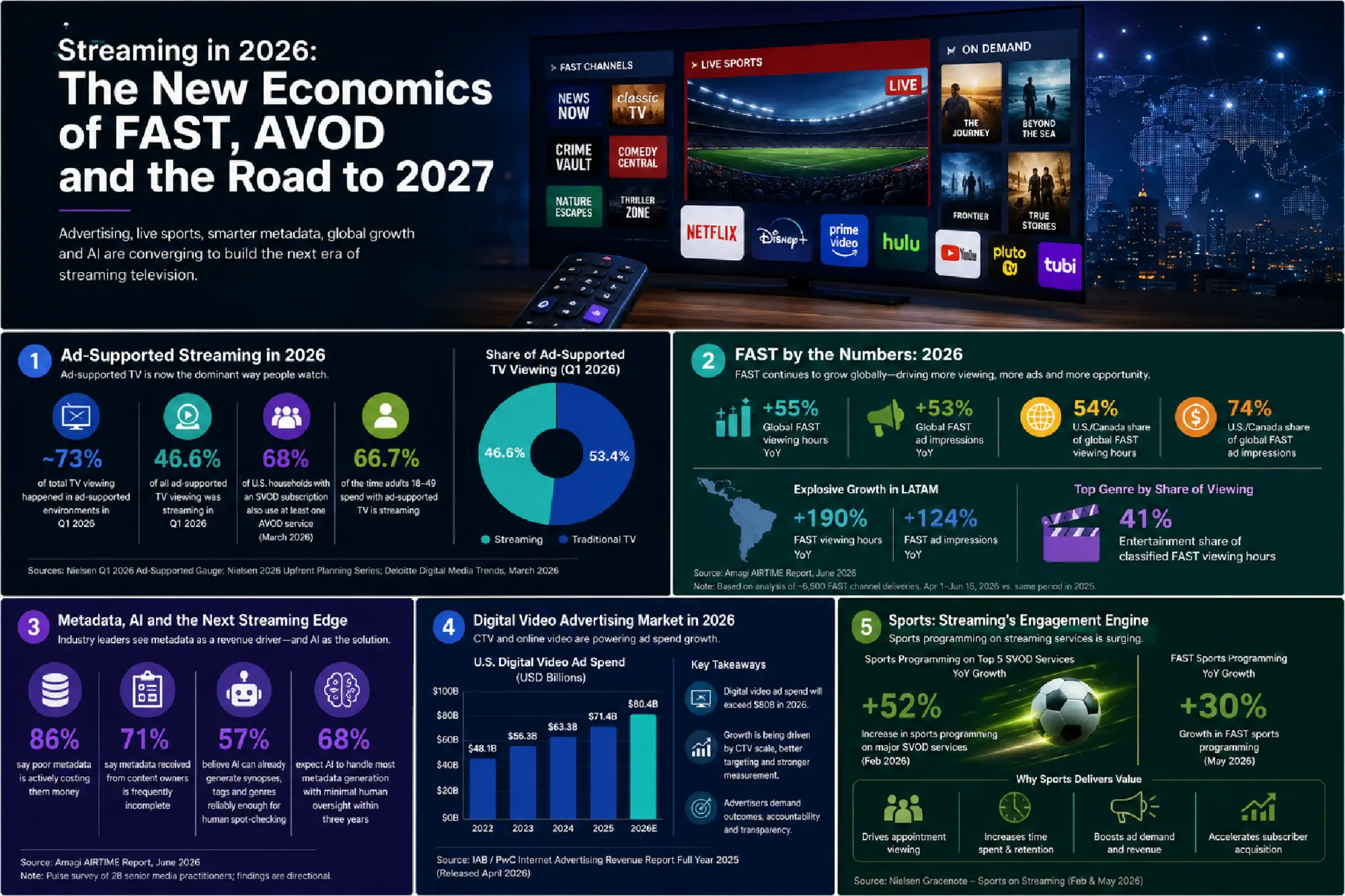
Nielsen reported that nearly 73% of total television viewing in the first quarter of 2026 occurred in ad-supported environments. More importantly, streaming captured a record 46.6% of all ad-supported television viewing during the quarter. (Nielsen)
Among younger viewers, the transition is even further along. Nielsen found that streaming represents 66.7% of the time adults 18–49 spend watching ad-supported television, while more than 81% of streaming viewing among that demographic takes place on ad-supported services such as YouTube, Hulu, Prime Video, Peacock and Paramount+. (Nielsen)
Deloitte's 2026 Digital Media Trends research points in the same direction. As of March 2026, 68% of U.S. households subscribing to SVOD also used at least one advertising-supported streaming service, compared with 54% only one year earlier. (Deloitte)
The implication is significant.
The industry spent much of the previous decade asking whether consumers would accept advertising in streaming. That question has effectively been answered.
They will.
The strategic question for 2027 is instead:
Who can deliver the best advertising-supported viewing experience and monetize it most efficiently?
2. Subscription Streaming Is Quietly Becoming an Advertising Business
The distinction between SVOD and AVOD is becoming increasingly artificial.
Netflix, Disney+, Prime Video, Peacock, Paramount+ and other major subscription platforms now operate advertising businesses alongside their subscription businesses. Apple TV and a handful of niche services remain notable exceptions.
S&P Global estimates that pricing for major U.S. streaming services has steadily increased, particularly for ad-free plans. From 2020 through early 2026, average pricing for ad-free plans grew at an annualized rate of roughly 7.7%, compared with 4.6% for entry-level plans, many of which now contain advertising. (S&P Global)
The strategy is increasingly obvious: make ad-supported subscriptions attractive enough that consumers choose them while pushing premium pricing upward for customers who insist on avoiding commercials.
The trend has accelerated during 2026. Peacock, for example, raised prices again in August, taking its Premium Plus ad-free service to $19.99 per month. Across the largest U.S. services, maintaining a portfolio of ad-free subscriptions can now easily exceed $100 per month. (The Verge)
Advertising therefore solves two problems simultaneously.
It keeps entry prices manageable for consumers while increasing average revenue per viewer for platforms.
Streaming Media reports that more than 70% of net new U.S. streaming subscriptions since 2023 have come from advertising-supported plans. (Streaming Media)
By 2027, describing Netflix, Amazon or Disney simply as "subscription streaming services" may no longer adequately describe their businesses. They are increasingly sophisticated advertising-supported television platforms that happen to collect subscription revenue as well.
3. FAST Is Mature—but It Is Still Growing Rapidly
FAST has transitioned from an experimental corner of streaming into a meaningful television distribution system.
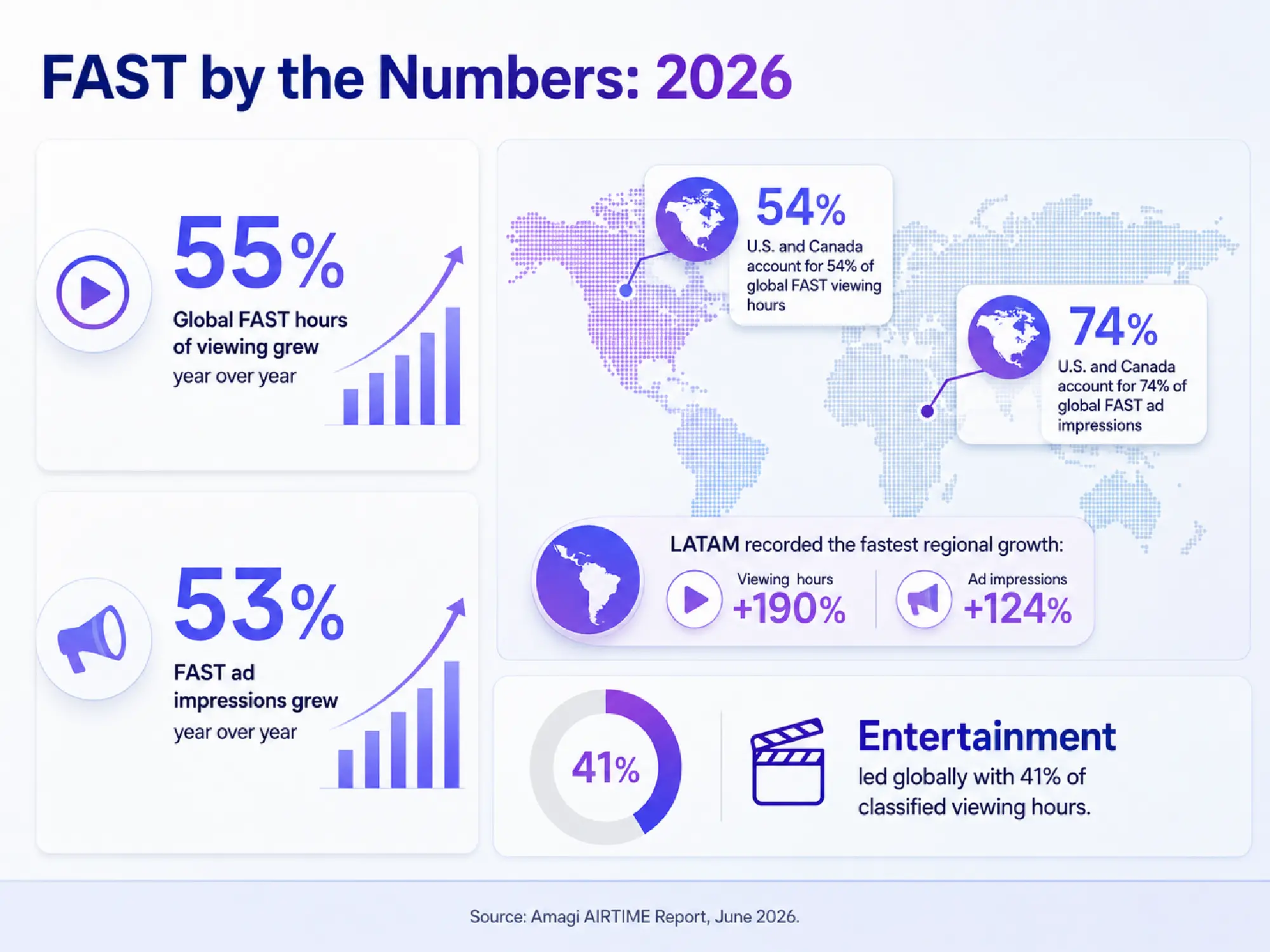
Amagi's June 2026 AIRTIME report analyzed roughly 6,500 FAST channel deliveries and found that global FAST hours of viewing increased 55% year-over-year, while ad impressions increased 53%. (Amagi)
Those numbers are particularly important because they indicate growth in actual consumption rather than simply growth in the number of channels being launched.
FAST household penetration in the United States appears to be approaching maturity. Circana data cited by CTAM found FAST usage leveling near 69% of households during the second half of 2025. (CTAM)
That suggests the next phase of FAST will be less about convincing households to try free television and more about increasing:
- viewing frequency,
- time spent,
- advertising yield,
- channel quality,
- content discovery,
- international expansion,
- and revenue per viewing hour.
FAST operators should therefore expect considerably more pressure on programming performance.
The era when almost any recognizable library could be turned into a channel and gain distribution is ending.
The emerging question is not:
"Can we launch another FAST channel?"
It is:
"Will audiences actually watch it?"
4. The Industry Is Moving From Channel Proliferation to Channel Quality
The first generation of FAST encouraged channel creation.
The second generation will encourage channel optimization.
FAST platforms now host hundreds—and in some cases thousands—of channels. That scale creates a discovery problem very similar to what occurred in SVOD: more content does not automatically result in more consumption.
Platforms therefore have greater incentive to favor channels that demonstrate:
- consistent viewing,
- recognizable programming,
- strong metadata,
- regular content refresh,
- good retention,
- differentiated positioning,
- and attractive advertising inventory.
This is likely to create a gradual rationalization of the FAST ecosystem through 2027. Weak channels may disappear. Others will merge. Some single-series channels may broaden into genre destinations.
Successful brands may operate multiple thematic channels built from overlapping libraries.
And operators will increasingly treat scheduling as an optimization problem rather than simply filling 8,760 hours of annual airtime.
For content licensors, this should increase demand for programming that can strengthen existing channels rather than necessarily justify creation of entirely new ones.
That distinction could substantially expand the market for backfill, refresh and supplemental library programming.
5. Content Refresh Is Becoming More Important Than Catalog Size
During the early years of streaming, catalog size functioned as a marketing metric.
"10,000 movies."
"50,000 episodes."
"Hundreds of channels."
But large libraries frequently contain programming that viewers rarely encounter.
For a FAST channel, repeating the same limited collection of programming creates an even more immediate problem: viewers notice.
Channel operators therefore increasingly need to rotate programming, fill schedule gaps, replace underperforming titles and experiment with new genres without acquiring massive new libraries.
That creates an increasingly important distinction between owning a library and programming a channel.
A channel may possess thousands of hours but still need several hundred new hours each year to remain fresh.
The economics also favor flexible licensing.
Rather than acquiring broad multi-year packages regardless of performance, operators can increasingly license smaller groups of content, evaluate performance and expand successful categories.
This creates an opportunity for marketplaces and licensing infrastructure capable of turning content acquisition into a recurring operational process rather than a months-long negotiation.
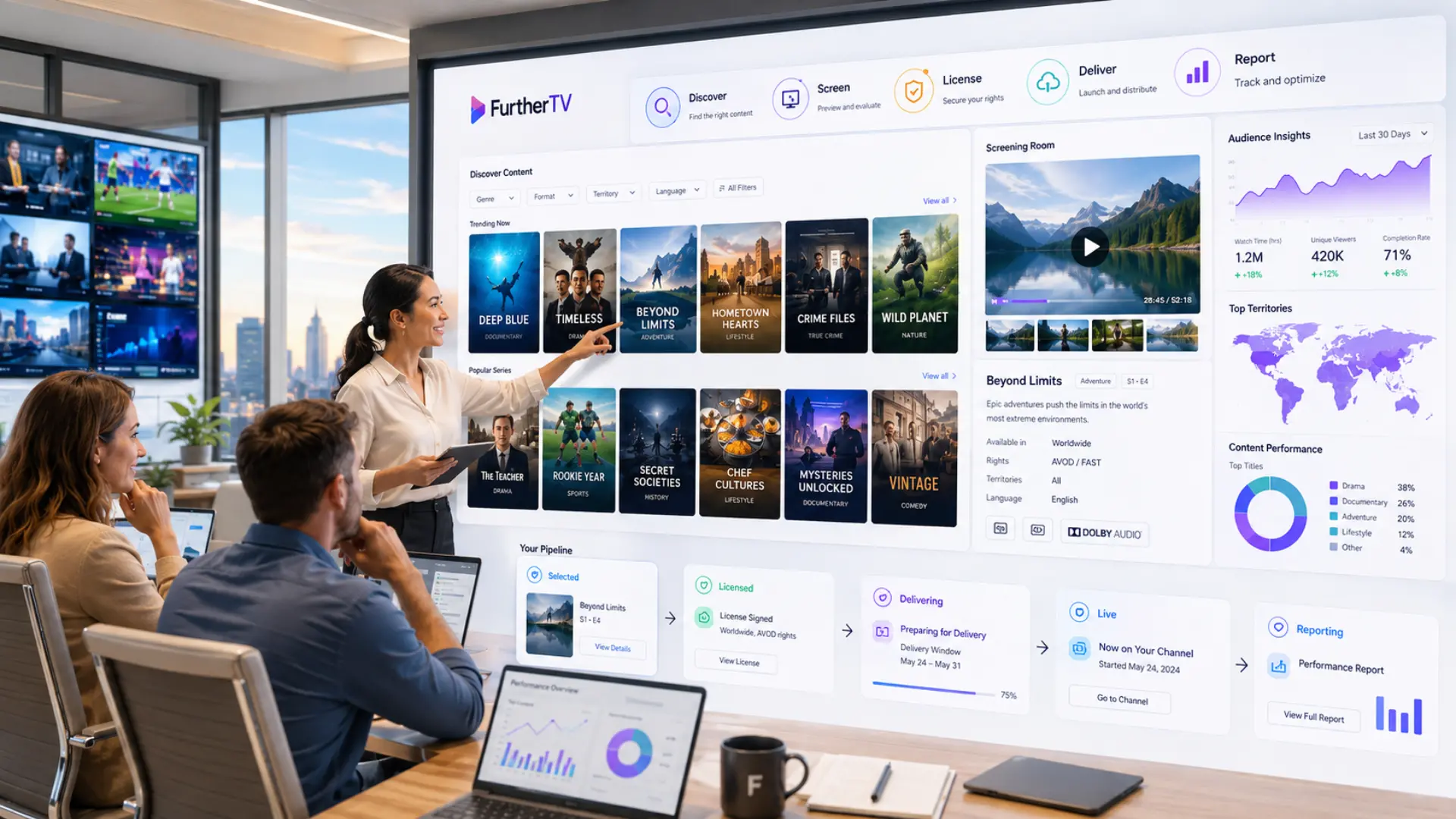
FurtherTV has previously examined this issue in detail: FAST channels depend heavily on affordable library programming, yet content discovery, rights negotiation, delivery and reporting remain surprisingly fragmented. (FurtherTV)
That fragmentation is likely to become increasingly difficult to sustain as the number of FAST programming transactions increases.
6. Library Content Is Becoming More Valuable Again
One of the less obvious outcomes of streaming's maturation is the renewed importance of older programming.
For years, media strategy emphasized premium originals.
Those originals remain important for subscription acquisition. But the economics of advertising-supported streaming are different.
A viewer spending an hour watching a ten-year-old documentary can generate advertising inventory just as effectively as someone watching a newly produced show—provided the older program attracts an audience.
This makes well-produced library programming particularly attractive for FAST and AVOD.
Categories likely to remain valuable include:
- documentaries,
- factual entertainment,
- crime,
- food and lifestyle,
- travel,
- reality,
- classic television,
- movies,
- children's programming,
- automotive,
- outdoor programming,
- history,
- sports archives,
- competition formats,
- and niche enthusiast programming.
Incremental licensing revenue therefore has the potential to carry very attractive margins for rights-holders.
For operators, meanwhile, licensing existing content can be dramatically cheaper than funding originals.
The result is a market where content that might previously have been considered "catalog inventory" increasingly functions as a monetizable operating asset.
7. Sports and Live Events Are Becoming Streaming's Most Valuable Programming
If library content provides inexpensive programming volume, live programming provides urgency.
Sports has emerged as one of streaming's strongest engagement engines.
Nielsen's Gracenote reported in February that sports programming available through major subscription platforms had increased 52% year-over-year. By May, sports represented approximately 5% of programming across leading global streaming catalogs, rising sharply from previous levels. (Nielsen)
The attraction is easy to understand.
Most movies and television programs can be watched tomorrow.
A championship game cannot.
Live events therefore generate appointment viewing, which increases:
- simultaneous audiences,
- session duration,
- advertising demand,
- subscription acquisition,
- social conversation,
- and retention.
Disney's recently announced global Formula E streaming agreement covering 144 territories is another example of streaming platforms aggressively pursuing live sports rights. (Reuters)
Prime Video is similarly expanding sports investment internationally, including a newly announced commitment of more than $2 billion to Latin American programming and sports between 2027 and 2030. (Reuters)
For FAST, an especially interesting opportunity exists below the tier of billion-dollar professional sports rights.
Hundreds of leagues, tournaments and events have passionate audiences but lack broad television distribution.
These may include:
- emerging sports,
- combat sports,
- motorsports,
- college and amateur competitions,
- international leagues,
- chess,
- esports,
- strongman events,
- racing,
- regional tournaments,
- festivals,
- concerts,
- and cultural events.
Expect significantly more experimentation with these categories in 2027.
8. FAST Is Becoming Increasingly Global
The United States remains FAST's largest advertising market, but international expansion is accelerating.
Amagi estimates the U.S. and Canada currently represent approximately 54% of global FAST viewing hours but 74% of global ad impressions, highlighting both North America's monetization advantage and the enormous potential for advertising growth elsewhere. (Amagi)
International growth creates a different programming opportunity than simply exporting American channels.
Localization matters.
Successful international channels increasingly require:
- local-language metadata,
- subtitles,
- dubbing,
- regionally relevant programming,
- locally recognizable brands,
- local advertising demand,
- and territory-specific rights.
This creates opportunities for content that may not historically have traveled widely.
Korean drama, anime, European crime programming, Latin American television, Asian factual programming and regional sports can all find global niche audiences through FAST.
Conversely, American and European library catalogs can be repackaged for territories where they have received limited historical exposure.
The likely result is a far more fluid international licensing market.
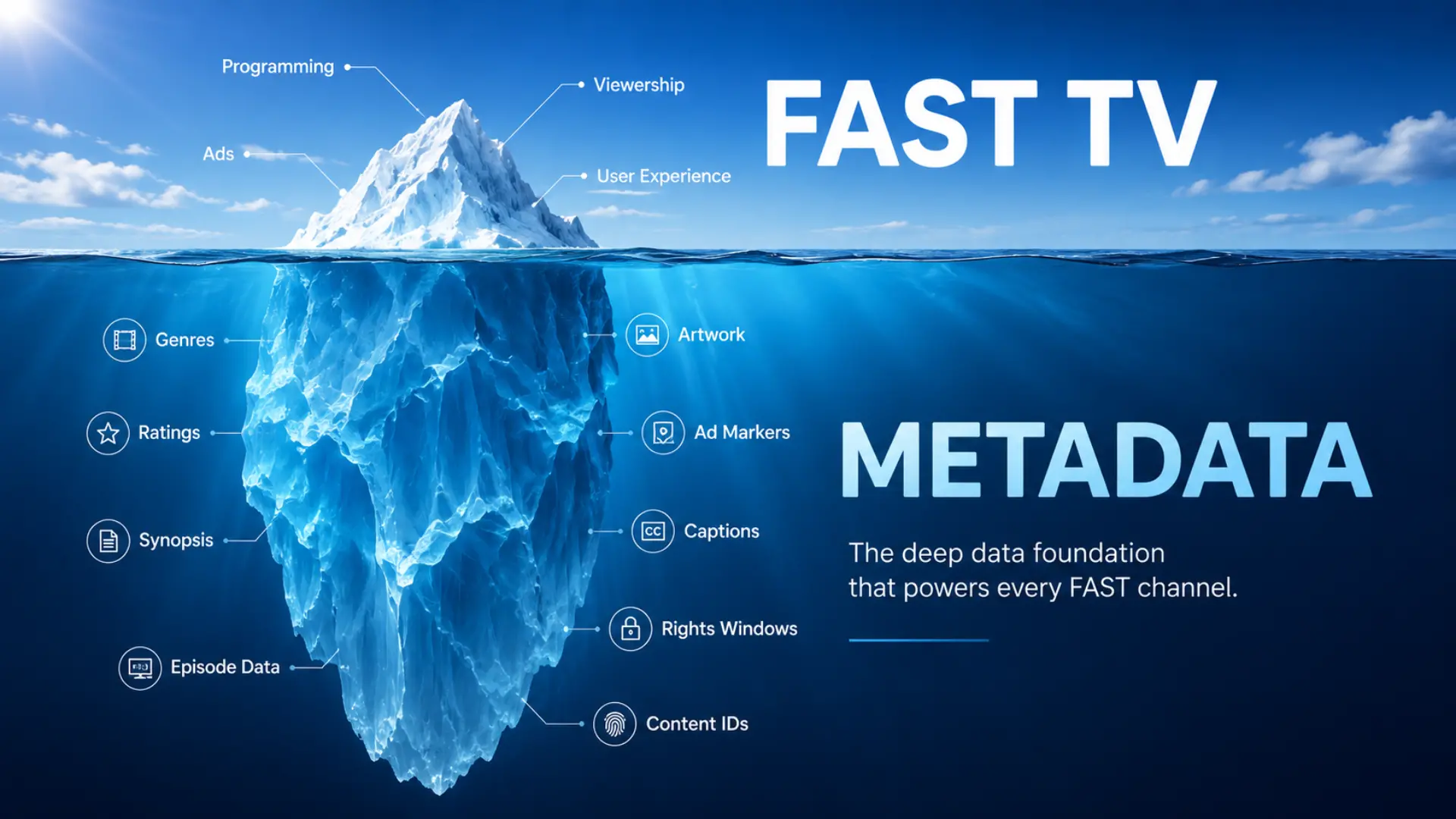
9. Metadata Has Become an Economic Asset
One of 2026's most important operational trends may sound mundane:
metadata.
As streaming catalogs grow, metadata determines whether content can be discovered, recommended, advertised and monetized.
Amagi's 2026 research found that 86% of surveyed industry practitioners said poor metadata is actively costing them money, whether through lost advertising, poor discovery or platform deprioritization.
Seventy-one percent said metadata received from content owners is frequently incomplete. (Advanced Television)
The problem extends far beyond titles and descriptions.
Modern streaming systems increasingly require information covering:
- genres,
- subgenres,
- themes,
- cast,
- locations,
- moods,
- topics,
- content ratings,
- episode relationships,
- imagery,
- languages,
- rights,
- ad-break placement,
- sports participants,
- objects,
- scenes,
- and contextual attributes.
Better metadata improves not only search but recommendation systems and advertising relevance.
PwC therefore argues that media companies should increasingly treat metadata as a revenue driver, not an administrative function. (PwC)
That shift will accelerate considerably as AI makes metadata generation cheaper.
10. AI Will Quietly Transform Streaming Operations Before It Transforms Entertainment
Generative video attracts headlines.
But many of the most commercially useful AI applications in streaming are less dramatic.
AI is increasingly capable of analyzing existing programming and generating:
- summaries,
- genres,
- keywords,
- chapter markers,
- scene descriptions,
- content classifications,
- advertising cues,
- object detection,
- locations,
- mood,
- pacing,
- character information,
- and recommendation attributes.
In Amagi's industry survey, 57% of respondents believed AI could already generate metadata such as synopses, tags and genres reliably enough that humans only needed to perform spot checks. Sixty-eight percent expected AI to handle most metadata generation with minimal human intervention within three years. (Advanced Television)
AI will also increasingly influence:
- programming schedules,
- audience segmentation,
- churn prediction,
- ad placement,
- content valuation,
- content acquisition,
- localization,
- caption generation,
- compliance,
- quality control,
- and promotional asset creation.
The result could be profound.
Historically, programming thousands of hours of television required large teams.
By 2027 and beyond, increasingly sophisticated systems may continuously analyze channel performance and recommend—or eventually execute—schedule changes automatically.
Streaming programming could become considerably more algorithmic.
11. AI Training Is Emerging as an Entirely New Content-Licensing Market
AI creates another opportunity for rights-holders that exists largely outside traditional streaming economics.
High-quality video libraries are valuable training data.
They contain combinations of:
- human movement,
- environments,
- objects,
- dialogue,
- emotion,
- camera movement,
- editing decisions,
- temporal relationships,
- audio,
- speech,
- music,
- multilingual captions,
- and structured narrative sequences.
As AI companies face increasing scrutiny over training data provenance and copyright, licensed media libraries may become increasingly attractive.
The broader publishing industry is already demonstrating the model. Large AI companies have entered licensing relationships with established media organizations partly because professionally produced archives provide high-quality, legally controlled datasets. (The Australian)
Video rights-holders may ultimately be able to treat AI licensing as a separate rights window alongside:
SVOD → AVOD → FAST → transactional → international → educational → AI training.
This market remains early and pricing models are not yet standardized.
But it could become a meaningful source of incremental revenue for large video libraries during 2027 and beyond.
Rights management will be critical. AI usage should be expressly licensed rather than assumed as part of ordinary streaming rights.
12. Advertising Is Becoming More Sophisticated—and More Accountable
CTV advertising initially benefited simply from following viewers away from linear television.
That honeymoon period is ending.
Advertisers increasingly expect streaming campaigns to demonstrate outcomes.
IAB estimates that U.S. digital video advertising spending will exceed $80 billion in 2026, but its research also emphasizes that advertisers increasingly demand better audience information, measurement, transparency and proof of business outcomes. (IAB)
This is pushing streaming advertising toward capabilities associated with digital performance marketing.
Expect continued development around:
- household targeting,
- contextual targeting,
- first-party audience data,
- frequency management,
- cross-platform measurement,
- attribution,
- interactive ads,
- pause ads,
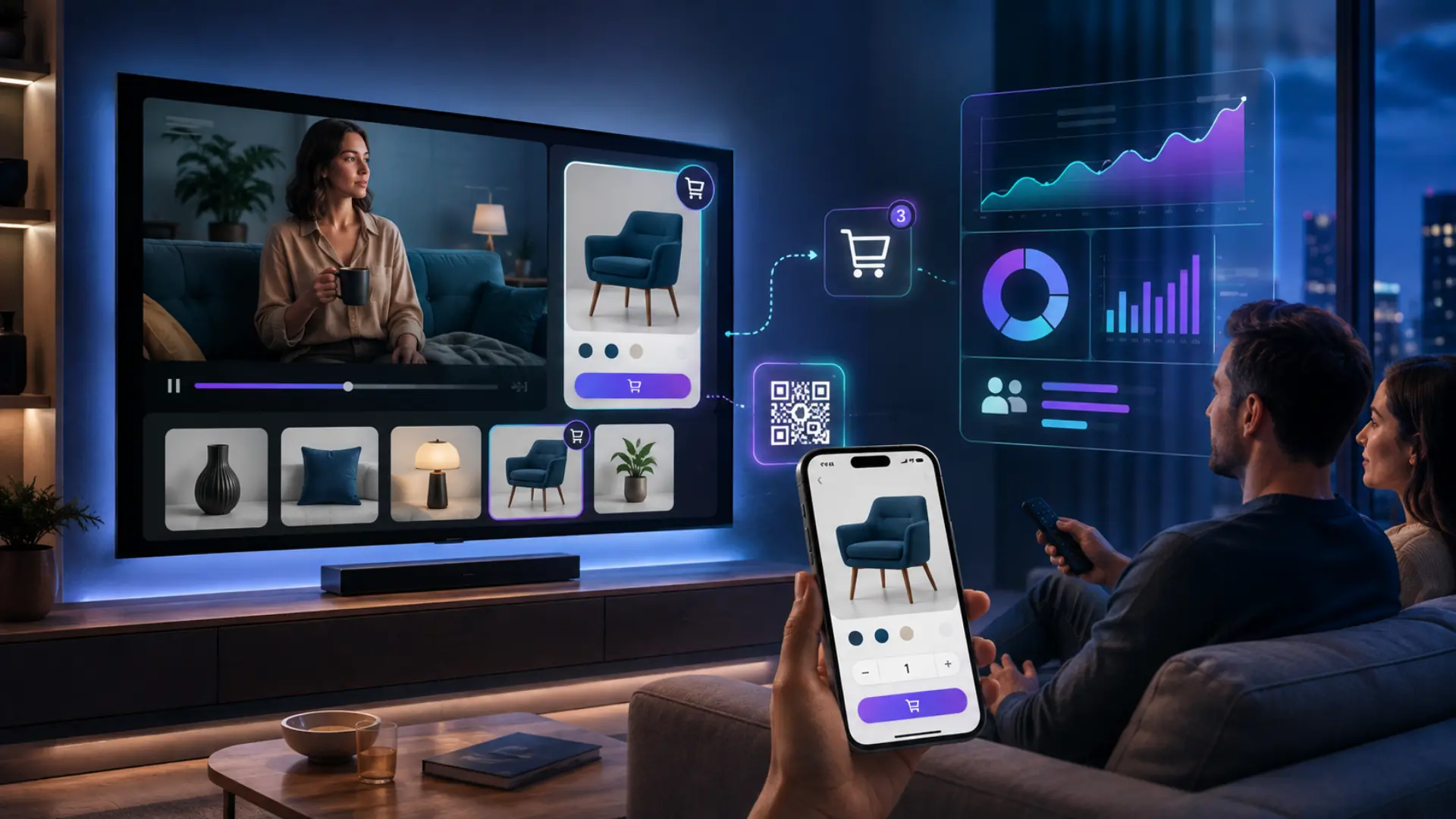
- shoppable television,
- QR engagement,
- outcome-based optimization,
- and AI-assisted media buying.
IAB also notes that interactive formats—including pause advertising and shoppable video—are moving beyond experimental deployments. (IAB)
For FAST operators, this matters enormously.
Increasing viewing hours is useful.
Increasing revenue generated from each viewing hour is better.
13. Measurement Remains One of Streaming's Biggest Unsolved Problems
Television used to have an imperfect but relatively understandable measurement system.
Streaming introduced hundreds of competing metrics.
A "view" may mean something entirely different on YouTube, TikTok, Roku, Netflix or a FAST service.
Advertisers meanwhile need to understand:
- who actually watched,
- for how long,
- whether the same person saw an ad elsewhere,
- whether the ad generated incremental reach,
- and whether exposure produced an outcome.
The industry is therefore gradually converging toward cross-media measurement rather than treating linear television, AVOD, FAST and digital video as separate universes.
Nielsen explicitly recommends that marketers approach linear television, streaming and FAST as one integrated advertising ecosystem. (Nielsen)
That philosophy is likely to become increasingly important in 2027.
Eventually advertisers may care considerably less whether an impression originated on a traditional cable channel, Peacock, Pluto TV or a niche FAST channel.
They will care about the audience, context, price and result.
14. The Smart-TV Home Screen Is Becoming the New Cable Bundle
Consumers escaped the cable bundle only to discover another problem:
too many streaming applications.
That fragmentation is producing a new generation of aggregators.
Smart-TV manufacturers and operating systems increasingly function as gateways controlling discovery across services.
Samsung, Roku, Amazon Fire TV, Google TV, LG and others can place:
- streaming applications,
- FAST channels,
- individual shows,
- sports,
- rentals,
- recommendations,
- live television,
- and sponsored content
within the same interface.
The implications are substantial.
The streaming service itself may no longer own the customer's first interaction with television.
The television operating system might.
That gives device manufacturers enormous influence over discovery and monetization.
It also favors content that can travel easily across multiple environments rather than remaining locked inside a single application.
15. Bundling Is Returning—but in a New Form
Cable television was a bundle. Streaming dismantled it. Now streaming is rebuilding it. Consumers increasingly face subscription fatigue, rising prices and too many interfaces.
Platforms are responding with bundles that combine multiple streaming services, telecommunications packages and device ecosystems.
The new bundle differs from cable because it can be assembled dynamically.
A customer might receive entertainment from Disney+, sports from ESPN, premium programming from another service and free channels through FAST—all presented through one interface.
By 2027, aggregation may become one of the industry's defining competitive advantages.
The most valuable companies may not necessarily be the ones producing the most programming.
They may be the ones best positioned between consumers and everybody else's programming.
16. Content Discovery Is Becoming as Important as Content Ownership
Streaming once assumed that unlimited choice was inherently valuable.
It turns out unlimited choice can be exhausting.
Consumers regularly spend significant time deciding what to watch.
FAST partially solves that problem through an old-fashioned mechanism:
someone else chooses.
Turn on a channel and something is already playing.
This simplicity is one of FAST's underappreciated strengths.
Expect services to increasingly combine lean-back and lean-forward experiences:
- curated FAST channels,
- personalized linear channels,
- traditional VOD search,
- AI recommendations,
- short-form previews,
- personalized home screens,
- and contextual programming feeds.
The ultimate streaming interface may therefore look surprisingly similar to television—but with every channel dynamically tailored to the viewer.
17. Short-Form and Long-Form Video Are Starting to Converge
Another trend worth watching is the growing overlap between television streaming and mobile-first video.
Vertical "microdramas" consisting of episodes often lasting only one or two minutes have become a rapidly expanding entertainment format. Reuters estimates the U.S. microdrama sector could reach approximately $1.5 billion in 2026 and $2 billion in 2027. (Reuters)
Traditional media companies are taking notice.
NBCUniversal, Fox and others have begun experimenting with short-form and vertical content, while sports services are incorporating social-style clips to complement full-length programming. ESPN, for example, is expanding short-form and personalized content around its direct-to-consumer experience. (Axios)
This does not mean vertical video will replace television.
It suggests that the distinction between social video and streaming television will become less rigid.
A single sporting event might generate:
- a live broadcast,
- a FAST replay,
- a condensed version,
- highlights,
- vertical clips,
- social posts,
- personalized compilations,
- and an on-demand archive.
The value of rights may increasingly depend on the ability to exploit all of those formats.
What This Means for 2027
Taken together, these developments point toward a streaming market that will look meaningfully different by the end of next year.
Several shifts appear particularly likely.
Advertising will become the industry's primary growth engine.
Subscription revenue will remain critical, but advertising is increasingly where incremental streaming growth is coming from. Platforms capable of combining scale with sophisticated targeting and measurement will have an advantage.
FAST will become more selective.
The number of channels may continue growing globally, but platforms will increasingly reward performance. Channels with stale programming, poor metadata or weak audiences will face greater difficulty maintaining distribution.
Content refresh will become a recurring procurement function.
Rather than occasionally acquiring huge libraries, channel operators will increasingly source programming continuously to maintain schedules and test audience demand.
Sports and live events will expand beyond the major leagues.
Premium rights will remain extremely expensive, pushing platforms toward emerging sports and other live events capable of generating dedicated audiences at far lower acquisition costs.
AI will become embedded throughout streaming operations.
Metadata generation, scheduling, recommendations, localization, content analysis, advertising and rights management will increasingly incorporate AI.
Rights will become more granular.
The same title may carry separate rights for AVOD, FAST, SVOD, clips, social distribution, international territories, AI training and other uses.
Managing those rights manually will become increasingly difficult.
International licensing will accelerate.
FAST expansion outside North America will increase demand for localized catalogs while opening new markets for rights-holders whose programming has previously received limited global distribution.
Streaming and television will effectively become the same market.
The distinction between "TV" and "streaming" is steadily disappearing.
For viewers, everything appears on the same television.
For advertisers, everything increasingly competes for the same budget.
And for content owners, nearly every distribution model is becoming another potential window through which the same underlying intellectual property can be monetized.
The Bigger Picture
The first streaming revolution was fundamentally about distribution.
Internet delivery broke the connection between television programming and cable infrastructure.
The second streaming revolution is about economics.
The industry is learning how to make internet television sustainably profitable.
And the answer increasingly involves ideas television has understood for decades:
advertising, programming, scheduling, syndication, sports, licensing and aggregation.
What has changed is the technology surrounding them.
FAST and AVOD combine television's traditional advertising model with digital distribution, global reach, programmatic advertising, enormous catalogs and increasingly intelligent recommendation systems.
That combination could produce an extraordinarily large marketplace.
The winners will not necessarily be the companies with the biggest libraries or the most channels.
They will be the organizations that can most efficiently connect content, audiences, distribution and monetization.
For FAST channels and AVOD operators, that means finding the right programming at the right economics.
For rights-holders, it means making libraries easier to discover, license and monetize across more windows.
And for the industry as a whole, it suggests that 2027 will be less about launching yet another streaming service—and much more about making the streaming ecosystem that already exists work better.