Shoppable TV in 2026: The Race to Turn Streaming Ads Into Transactions
Connected television advertising is undergoing a fundamental change.
For decades, television advertising was primarily a persuasion medium. An advertiser could create awareness, generate interest and perhaps influence a consumer to visit a store later, but the television itself rarely participated in the transaction.
Streaming is changing that.
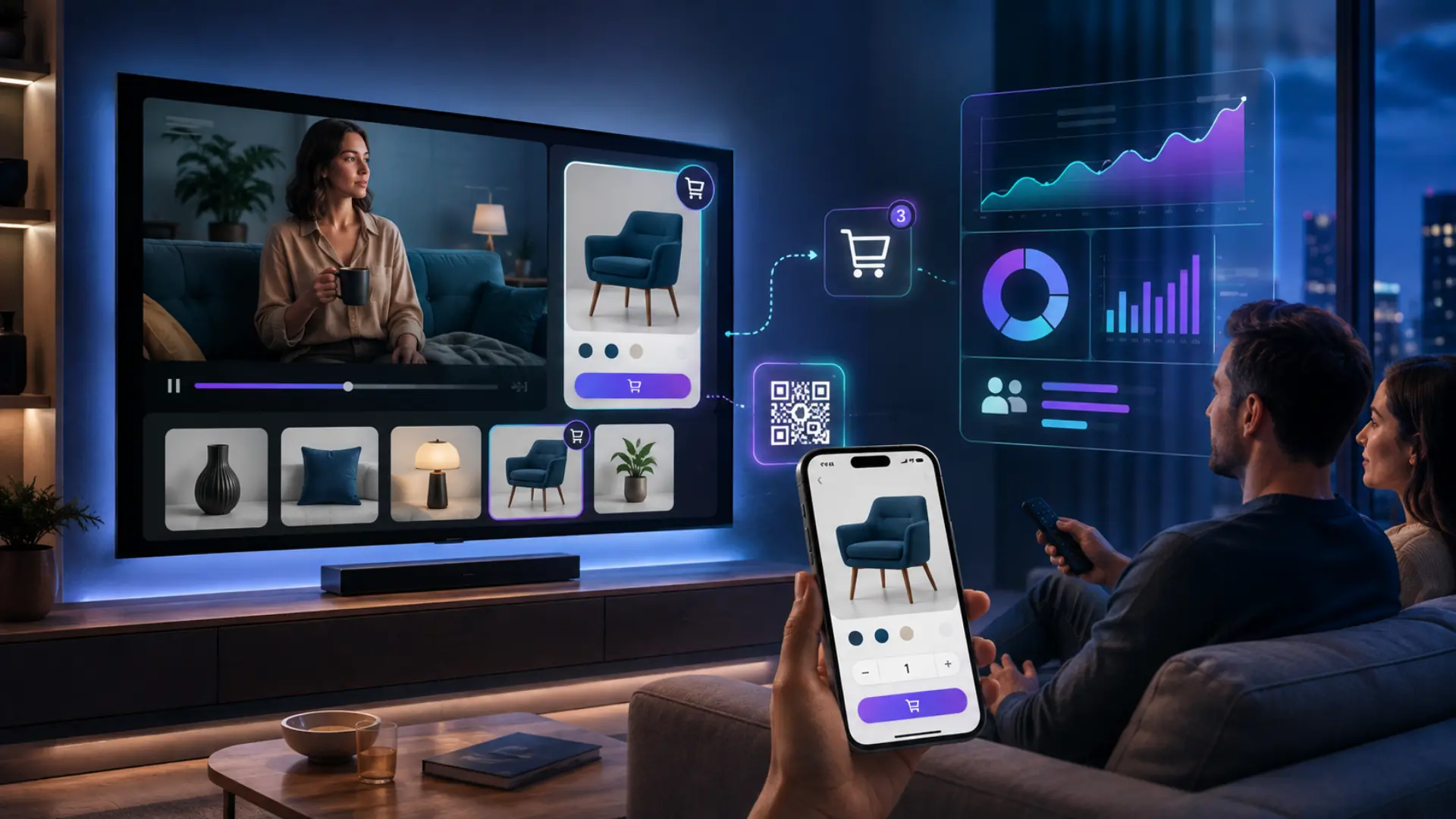
A growing class of shoppable and interactive CTV advertising now lets viewers browse products, request information, send an offer to their phone, add merchandise to a shopping cart—or, increasingly, complete much of the purchase process directly from the television.
The technology is evolving quickly enough that the most sophisticated implementations in 2026 barely resemble the QR-code experiments that defined early shoppable television.
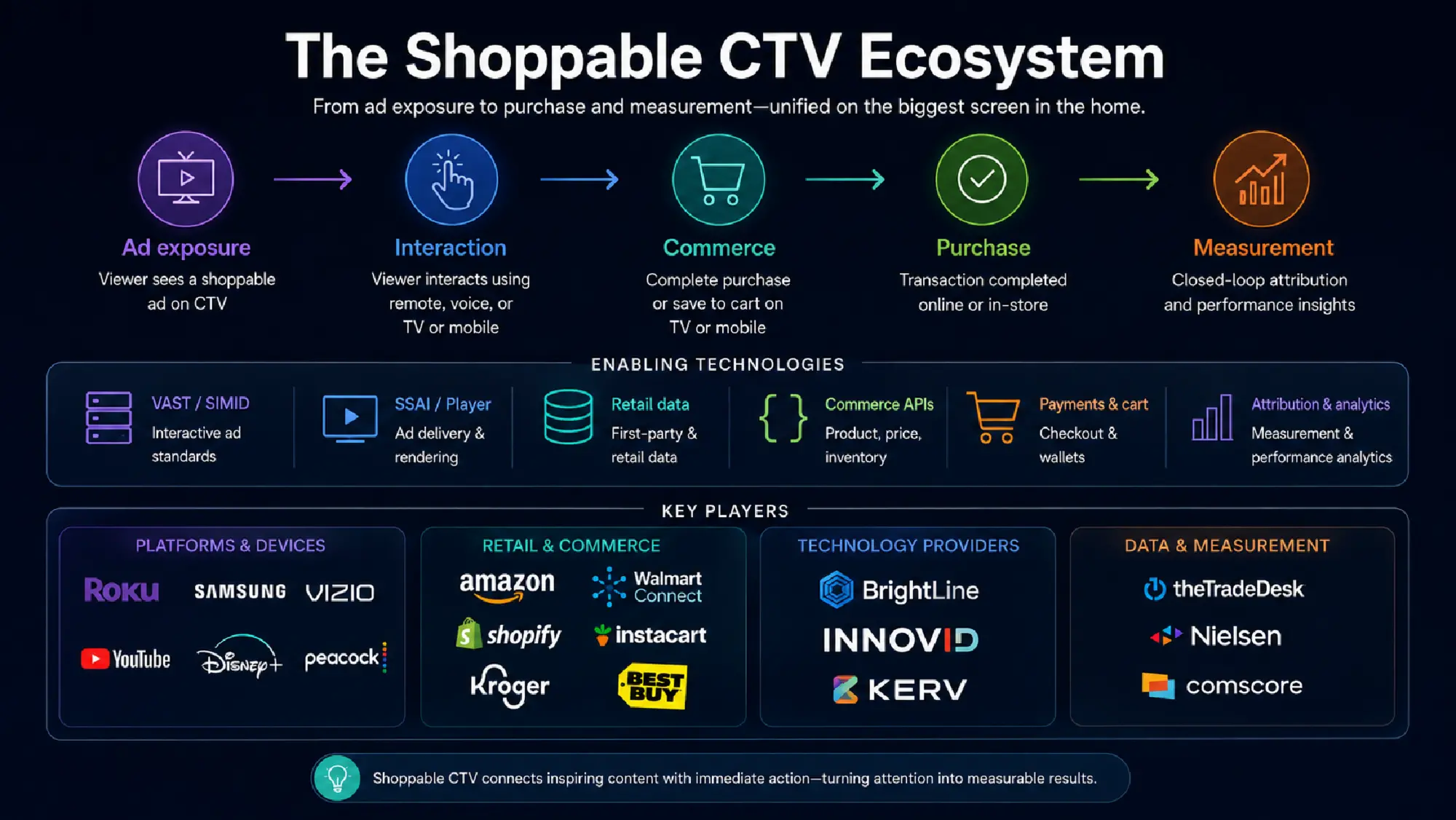
Amazon, Roku, Samsung, Walmart/VIZIO, Google/YouTube, Disney and NBCUniversal are all approaching the opportunity from different directions. At the same time, technology providers such as BrightLine, Innovid and KERV are building the infrastructure that allows interactive commerce experiences to work across publishers and device ecosystems.
The result is the emergence of a new category that sits at the intersection of CTV advertising, retail media, e-commerce and streaming technology.
And early campaign results suggest the opportunity could be significant.
Why Shoppable Television Matters Now
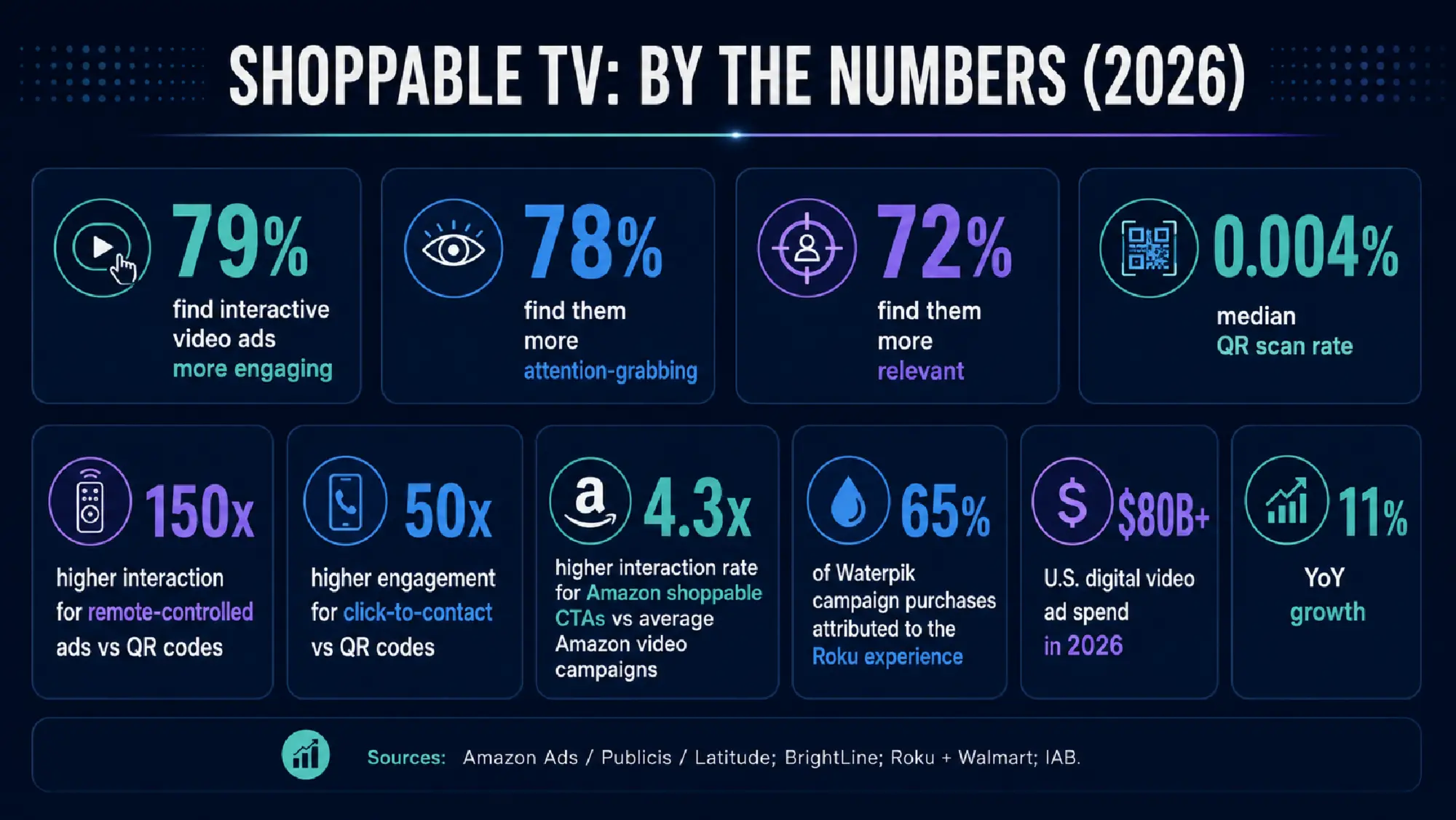
The broader digital video advertising market is already enormous. IAB projects U.S. digital video advertising spending to exceed $80 billion in 2026, growing approximately 11% year-over-year and faster than the overall advertising market. CTV is one of the major components of that spending.
What advertisers increasingly want from CTV, however, is not simply reach.
They want outcomes.
That means connecting television exposure with measurable actions such as:
- website visits,
- product consideration,
- app installs,
- store visits,
- add-to-cart events,
- and actual purchases.
- Shoppable television attempts to collapse what was traditionally a long sequence—
TV exposure → memory → search → product page → checkout
—into something much closer to:
TV exposure → action → transaction.
That seemingly small difference changes the economics of television advertising.
If a streaming platform can demonstrate that an advertisement produced an actual sale, CTV begins competing not only with traditional television budgets but with search advertising, social commerce and retail media.
The Market Leaders
There is no single undisputed leader because different companies control different parts of the transaction.
Amazon arguably has the strongest commerce infrastructure.
Roku has built one of the most mature native TV transaction experiences.
Samsung controls an unusually powerful combination of television hardware, operating system, streaming service, advertising inventory and first-party device data.
Walmart and VIZIO are creating one of the industry's most interesting combinations of retail transaction data and television operating-system distribution.
Disney and NBCUniversal are particularly advanced at integrating commerce with premium entertainment.
Google is bringing commerce capabilities to YouTube's enormous CTV audience.
Meanwhile, BrightLine, Innovid and KERV increasingly function as the connective tissue allowing sophisticated interactive creative to operate beyond a single walled garden.
The competitive landscape
| Company | Core advantage | Most advanced capability |
|---|---|---|
| Amazon Ads | Commerce data + checkout ecosystem | Remote/phone interaction, add-to-cart and closed-loop commerce measurement |
| Roku | TV OS + payments + commerce partners | Remote-controlled shopping, Roku Pay, Shopify and retailer integrations |
| Samsung Ads | Hardware + OS + FAST + device data | Amazon cart integration directly from Samsung TV Plus |
| Walmart / VIZIO | Retail data + TV operating system | Walmart shopper data, VIZIO/onn. TV scale and purchase attribution |
| Google / YouTube | Massive CTV audience + Merchant Center | Dynamic shoppable CTV through Demand Gen |
| NBCUniversal | Premium content + fandom | Commerce embedded into Peacock and programming |
| Disney | Premium streaming + interactive ad formats | Dynamic product detection, carousels, QR/mobile commerce |
| BrightLine | Cross-publisher interactive CTV | Remote-controlled product galleries, advergames and dynamic retail feeds |
| Innovid | Creative infrastructure + measurement | Shoppable formats across many devices and publishers |
| KERV | AI video analysis + commerce mapping | Automatically identifying products in video and linking them to live commerce feeds |
Amazon: Probably the Most Complete Commerce Engine
Amazon enters shoppable CTV with an advantage few competitors can replicate.
It already knows what millions of consumers search for, browse, purchase, subscribe to and place in shopping carts.
Amazon's interactive video ads allow viewers to use either a remote control or phone to take actions such as learning more about a product or adding it to their Amazon shopping cart.
Amazon reports that the interaction rate for shoppable calls-to-action in interactive video ads is 4.3 times higher than the detail-page-view rate of the average Amazon video advertising campaign.
More importantly, Amazon is beginning to export its interactive advertising technology beyond its own devices.
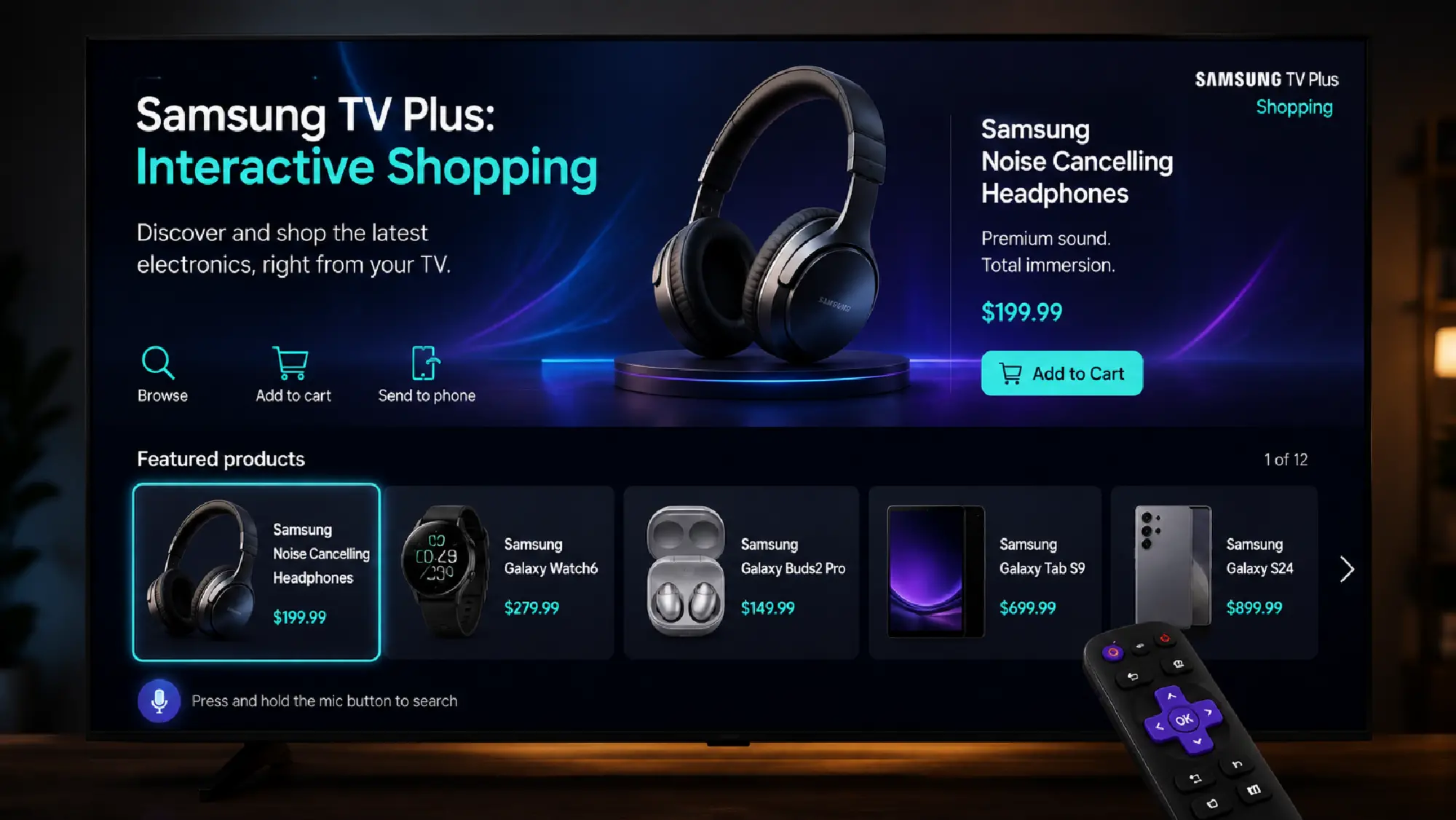
In 2026, Samsung announced that Samsung TV Plus would become the first FAST service outside Fire TV to integrate Amazon's interactive video advertising technology.
Viewers will be able to add products directly to an Amazon cart, send product information to a phone, or sign up for a service without leaving the TV experience. Samsung describes the system as enabling closed-loop attribution from advertisement exposure through purchase.
That is strategically important.
Amazon is effectively beginning to turn its checkout and commerce infrastructure into an advertising utility for other television platforms.
If that strategy expands, Amazon could become something akin to the commerce layer underneath shoppable television.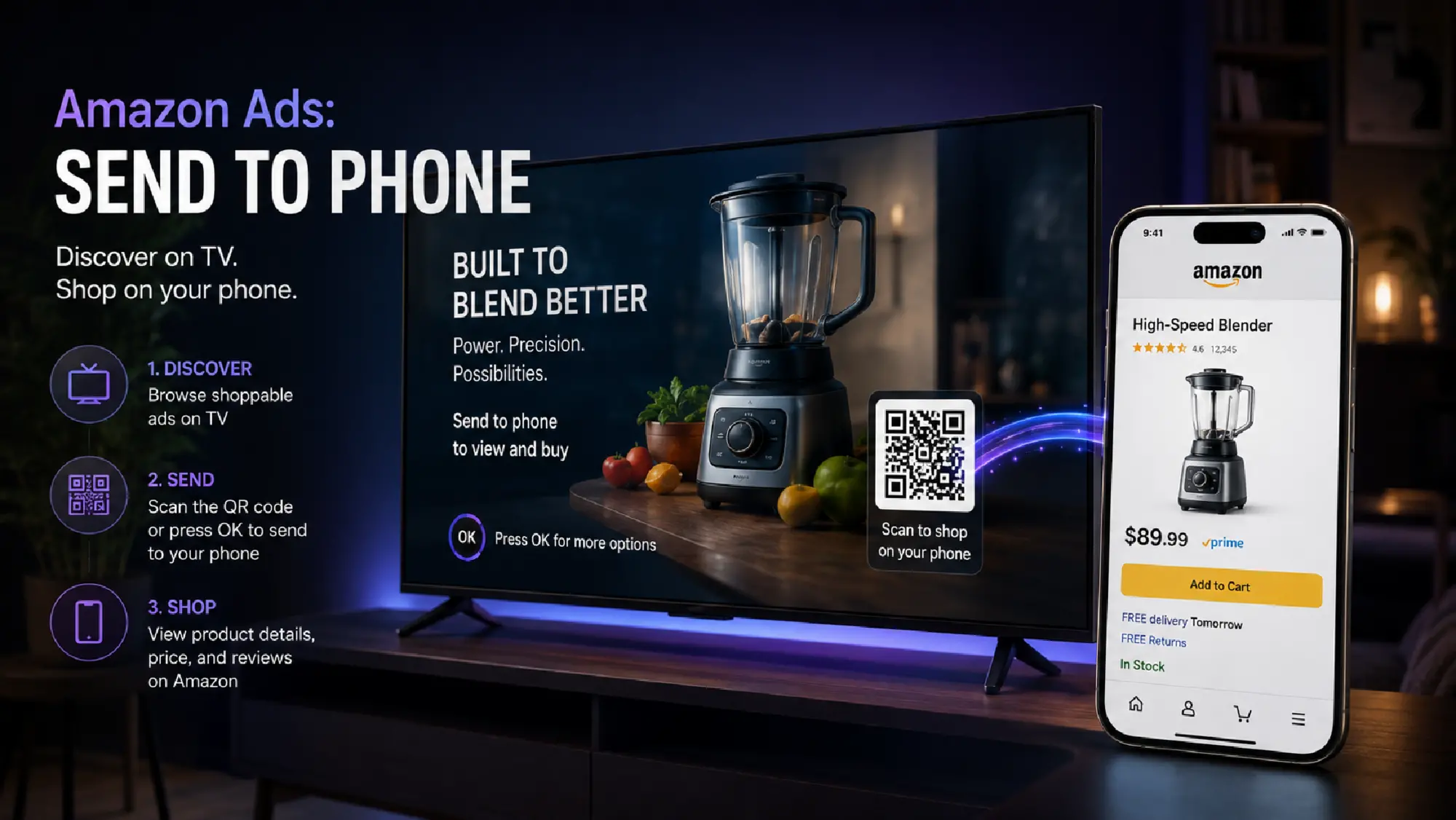
Roku: The Most Mature Native TV Shopping Experience
Roku has been experimenting with television commerce for several years and remains one of the most advanced implementations of true remote-control shopping.
Its partnership with Walmart allows viewers to press OK on their Roku remote when a shoppable advertisement appears.
Roku can then use stored Roku Pay information to simplify checkout, eliminating much of the friction of manually entering payment and shipping information.
Roku has subsequently expanded its commerce ecosystem significantly.
Its current commerce partners include Walmart, Instacart, Kroger Precision Marketing, Fandango, Shopify and Best Buy, allowing marketers to combine streaming exposure with retail purchase data and closed-loop measurement.
The Shopify integration is particularly interesting because it brings shoppable television down-market.
A merchant does not necessarily need to be Procter & Gamble or Coca-Cola to experiment with interactive CTV.
Roku Ads Manager allows Shopify merchants and other advertisers to launch interactive Action Ads through a relatively simple self-service workflow.
That changes the potential scale of the market.
Shoppable television stops being an experimental custom format available only to large national advertisers and becomes something smaller direct-to-consumer brands can test.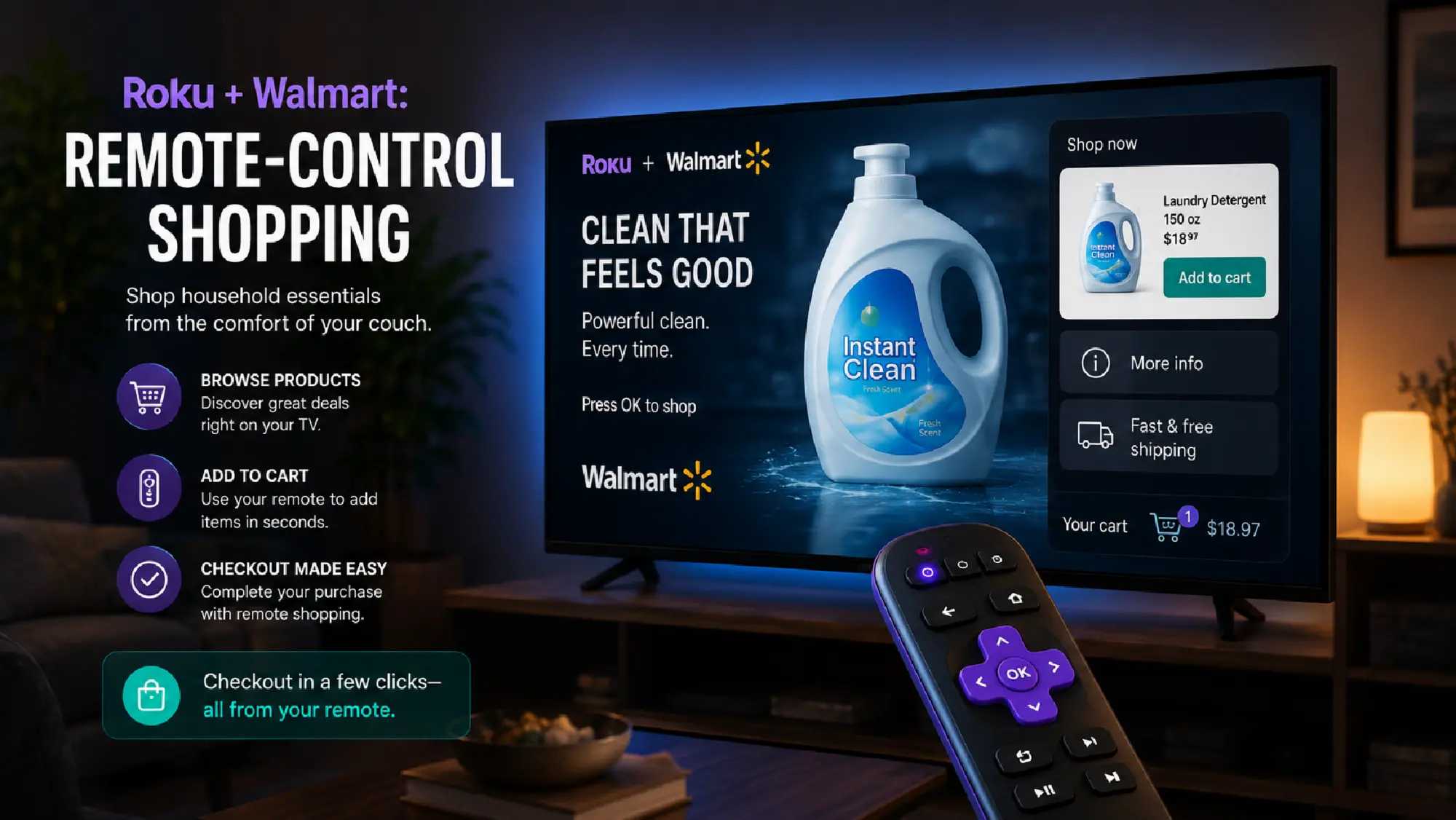
Roku Campaign Results Suggest Real Commerce Potential
A Waterpik campaign using Roku and Walmart Connect provides one of the better documented examples of native television commerce.
Viewers could press OK on the Roku remote and proceed toward checkout.
According to Roku and Walmart's campaign data, 65% of the campaign's attributed purchases occurred through the Roku experience rather than Walmart.com or Walmart stores. In-funnel conversion rates were 1.67 times campaign benchmarks, while the campaign produced an additional 21% household reach beyond the advertiser's linear television buy.
Roku has also reported that remote-based interaction significantly outperforms less integrated calls to action.
In early A/B testing, presenting viewers with a clear remote-control purchase instruction improved response rates by roughly four times compared with earlier approaches.
A more recent Roku analysis found a 96% correlation between dwell time on shoppable units and purchases, with viewers spending an average of approximately 24 seconds interacting with those units.
There are also examples involving smaller direct-to-consumer companies.
Wellness brand fatty15 used Roku's Shopify integration and reported more than 97,000 page views, 120% ROAS and a greater-than-25% conversion rate from cart additions to purchases.
Furniture brand Blu Dot reported an overall 2,308% ROAS from a Roku Ads Manager campaign using Roku's Shopify integration. This is a vendor case study rather than an independent controlled experiment, so the number should be interpreted accordingly, but it demonstrates the kinds of attribution Roku is now able to provide.
Samsung: Turning the Television OS Into a Performance Platform
Samsung may ultimately be one of the most strategically important companies in shoppable television because it owns the physical device.
Samsung can potentially observe and coordinate activity across:
- the television hardware,
- the operating system,
- Samsung TV Plus,
- the advertising layer,
- and other Samsung devices.
In 2026 the company formally positioned its advertising business around Performance TV, attempting to move CTV beyond awareness toward measurable outcomes.
Samsung says its interactive advertising formats deliver 17 times greater engagement than the industry average for interactive ads.
During a live Jonas Brothers concert on Samsung TV Plus, its remote-controlled FanVote experience reportedly generated interaction 26 times higher than typical QR-code engagement.
Its 2026 interactive formats include product galleries, vertical-video experiences and click-to-email functionality.
But the most consequential development is the Amazon integration.
Once deployed, Samsung TV Plus viewers will be able to interact with an advertisement using the television and send a product into the Amazon purchase funnel.
That represents a major evolutionary step: the TV platform no longer needs to own the retailer.
It simply needs a commerce API.
Walmart + VIZIO: A Potentially Powerful Combination
Walmart's acquisition of VIZIO created one of the more consequential combinations in the CTV advertising market.
Walmart owns enormous amounts of purchase data.
VIZIO controls a television operating system and advertising environment.
Walmart has also expanded that operating system onto its onn. television hardware, meaning the same commerce-capable software platform can potentially reach households through multiple television brands.
The strategic opportunity is obvious.
A consumer could see an advertisement on a Walmart-connected television platform.
Walmart could use purchase history to help determine whether that consumer is a likely buyer.
The consumer could interact with the advertisement.
And Walmart could determine whether the household ultimately purchased the advertised product either online or in a physical store.
That is the long-promised idea of closed-loop television advertising.
Walmart Connect is already expanding access to its first-party audiences and sales measurement across outside CTV inventory, including VIZIO supply, through partners such as Magnite.
The significance is bigger than VIZIO alone.
Retail-media data is beginning to escape the retailer's own website and travel into premium video inventory.
YouTube: Shoppable CTV at Enormous Scale
Google's approach is naturally tied to its advertising and merchant infrastructure.
Demand Gen now supports Shoppable CTV, where product information can be connected to YouTube advertising displayed on television screens.
Google reported in January 2026 that Demand Gen campaigns including TV screens produced an average of 7% additional conversions at the same ROI, based on a Google global experiment conducted in 2025.
That advantage should not be underestimated.
Google already connects:
- advertisers,
- product feeds,
- search intent,
- YouTube viewing,
- Merchant Center,
- Google Ads optimization,
- and conversion measurement.
Adding the largest screen in the home to that ecosystem requires fewer new systems than it would for a traditional broadcaster.
Google's challenge is that the actual shopping interaction often still uses a second screen rather than true TV-native checkout.
Amazon and Roku currently have a stronger position in direct remote-controlled transactions.
NBCUniversal: Turning Entertainment Itself Into the Storefront
NBCUniversal represents a different model.
Rather than simply placing interactive commerce technology inside standard advertisements, NBCUniversal increasingly integrates shopping with programming and fandom.
The company has experimented with ShoppableTV, Must ShopTV, Virtual Concessions, interactive Peacock formats, pause advertising and commerce-enabled content.
In June 2026, NBCUniversal launched Shop What Happens, a Bravo commerce program sponsored by Target.
The content runs across Peacock, YouTube, TikTok and Instagram, with different transaction mechanisms depending on the platform. Peacock living-room viewing uses QR codes, while mobile experiences can support text-to-shop and click-to-shop functionality.
NBCUniversal reports that commerce activations combining storytelling, intellectual property and talent have produced a 378% increase in engagement, while its commerce business has experienced 60% year-over-year purchase growth. These are NBCUniversal-reported portfolio figures rather than independent experiment results.
Peacock is also turning pause moments into commerce inventory.
NBCUniversal reports that certain shoppable full-screen Pause Ad deployments have generated as much as a 74% increase in ad memorability and 100% increase in foot traffic.
NBCUniversal's competitive advantage is therefore less about owning payment infrastructure and more about owning the content environment in which products become culturally desirable.
Disney: AI-Powered Product Recognition Meets Streaming Commerce
Disney has pursued interactive advertising aggressively through Hulu, Disney+ and its broader streaming portfolio.
Its Gateway Go platform uses QR codes, email, push notifications and other second-screen mechanisms to move viewers from television to an advertiser's offer.
Gateway Shop goes further.
The format combines television advertising with dynamic product information, a mobile storefront and audience targeting. Disney also provides reporting spanning viewer exposure through mobile shopping activity.
The most technologically interesting portion of Disney's system is its use of KERV.
KERV's AI analyzes the commercial itself, identifies products visible in the video and maps those products against retailer product catalogs.
That means a traditional video advertisement can potentially become shoppable without a producer manually defining every product displayed.
Disney and KERV also support product carousels, dynamic QR codes and graphical overlays.
Disney has additionally introduced Shop The Stream with Shopsense, creating curated digital storefronts based on products or themes appearing within Disney programming.
This points toward an important future development:
the shoppable unit may ultimately be the content itself—not merely the advertisement.
BrightLine: One of the Most Advanced Independent CTV Interaction Platforms
BrightLine is particularly important because it is not tied to a single streaming platform.
Its technology provides interactive CTV formats that publishers and advertisers can deploy across participating environments.
BrightLine supports experiences including:
- product galleries,
- remote-controlled selection,
- polls,
- interactive video,
- advergames,
- localized offers,
- product carousels,
- and click-to-contact experiences.
Its retail carousel can connect through APIs to product feeds and display current offers or products while the consumer watches television.
BrightLine's DynamicAI technology is designed to optimize these interactive experiences based on actual viewer engagement.
BrightLine is also now a Walmart Connect partner, allowing Walmart first-party purchase data and closed-loop measurement to be combined with BrightLine interactive creative.
That combination—creative interaction plus purchase data—is one of the strongest models in the market.
QR Codes May Already Be Becoming the “Old” Shoppable TV Technology
One of the most interesting findings in current CTV research is that QR codes appear significantly weaker than truly native interaction.
BrightLine reports a median QR scan rate of just 0.004% in its dataset.
By comparison, it says remote-controlled interactive television advertisements can produce interaction rates more than 150 times higher.
Its click-to-contact formats are reported to generate approximately 50 times the engagement of QR codes.
QR codes still have an important advantage: universality.
They require almost no integration with the television platform.
A QR code can simply be embedded inside the video.
Remote interaction requires cooperation from the operating system or player.
So QR codes are unlikely to disappear.
But they increasingly look like the transitional technology between passive TV advertising and native interactive television.
Gamification Can Produce Remarkably High Engagement
BrightLine has also demonstrated how interaction can move beyond shopping buttons.
A national retailer ran an interactive holiday adgame where viewers selected gifts using their remote.
The campaign generated at least one engagement across more than 1.3 million impressions, with users playing approximately two rounds during a 30-second experience.
The reported engagement rate reached 7.88%, roughly 13 times BrightLine's benchmark for scrollable interactive ads.
The QR code displayed after gameplay was also scanned four times more often than the company's typical interactive-ad QR benchmark.
This illustrates a broader point.
Shoppable CTV should not necessarily be thought of as "putting a Buy button on television."
The most effective experiences may involve entertainment, interaction and commerce together.
Innovid: Making Interactive Commerce Portable
Innovid plays another important role: enabling advertisers to build interactive experiences that can operate across many devices and publishers.
Its platform currently supports more than 15 interactive advertising formats and more than 25 device types.
Formats include:
- product galleries,
- QR interactions,
- shoppable ads,
- interactive overlays,
- surveys,
- and live-event experiences.
Innovid reports that advanced shoppable CTV formats can generate as much as 309% higher engagement and 34 additional seconds of attention relative to standard pre-roll video.
A Roundel/Target campaign for Enfamil provides a useful example.
The campaign used Innovid-powered shoppable CTV creative with both Scan-to-Shop and Scan-to-Add-to-Cart calls to action.
The campaign reportedly generated:
3x higher ROAS, 2x higher sales per thousand impressions and more than 15 million impressions.
Within the campaign, audiences who had recently purchased baby-related products generated more than 31% higher ROAS.
Again, these are campaign/vendor-reported figures rather than an independently replicated industry benchmark.
What Consumers Actually Want
Shoppable television works only if viewers are willing to interact.
Evidence increasingly suggests they are—but convenience matters enormously.
Amazon and Publicis Media commissioned Latitude to study more than 7,800 U.S. consumers across ten brands.
The research found that 79% considered interactive video advertisements more engaging than standard video, 78% considered them more attention-grabbing and 72% considered them more relevant.
For brands selling on Amazon, interactive formats generated approximately 3–4 percentage-point increases in brand opinion, consideration, purchase intent and recommendation versus standard ads.
Add-to-cart advertising with promotional messaging produced an 11-point increase in perceived innovation, nine points in convenience and seven points in noticeability.
LG Ad Solutions research points toward similar consumer interest.
In its 2025 Shoppable TV study, 70% of CTV viewers said they would save products to a TV wishlist to purchase later, 60% said they would store shipping and payment information on their television for faster checkout, and 62% said they would use voice interaction through a smart-home device to add products.
The implication is important.
Consumers may not necessarily want to conduct a complicated checkout process with a television remote.
But they appear increasingly comfortable using the TV as the beginning of a transaction.
The Most Advanced Features in Shoppable CTV
The state of the art in 2026 extends considerably beyond QR codes.
The most sophisticated platforms now combine several capabilities:
| Capability | Why it matters |
|---|---|
| Remote-control interaction | Eliminates the need to reach for a phone |
| Add-to-cart | Captures purchase intent immediately |
| Stored checkout credentials | Reduces checkout abandonment |
| Send-to-phone/email/text | Moves the transaction naturally to a personal screen |
| Dynamic product feeds | Shows current products, pricing and offers |
| Real-time inventory | Prevents advertising unavailable products |
| Product carousels | Allows multiple products inside one TV ad |
| AI visual recognition | Automatically identifies products appearing in video |
| Store-location lookup | Connects streaming ads with physical retail |
| Retail purchase data | Targets audiences based on actual shopping behavior |
| Closed-loop sales measurement | Connects ad exposure with online and physical-store purchases |
| Interactive pause ads | Monetizes natural viewing breaks |
| Gamification | Creates engagement before presenting commerce |
| Dynamic creative optimization | Changes products or calls to action based on audience/context |
| Programmatic delivery | Allows interactive formats to scale through normal ad buying |
| Content-integrated commerce | Makes products inside programming directly shoppable |
The progression is straightforward:
QR code → remote interaction → add-to-cart → stored checkout → dynamic product feed → closed-loop attribution.
The companies furthest along that sequence have the strongest strategic position.
The Technology Underneath Shoppable CTV
Making these experiences work at scale is more complicated than it appears.
A normal streaming advertisement can be delivered as video.
A shoppable advertisement requires communication between the creative, video player, streaming application, device operating system and often an external commerce service.
The industry is gradually standardizing that interaction.
The IAB Tech Lab identifies VAST as the core mechanism used to describe and deliver video advertising metadata.
For interactive experiences, the IAB supports SIMID—Secure Interactive Media Interface Definition.
SIMID allows interactive advertising creative to communicate with the media player while remaining sandboxed from the underlying player and device environment.
This distinction becomes especially important with server-side ad insertion.
Traditional interactive web advertising frequently relied on technologies such as VPAID, which are poorly suited to modern CTV environments.
SIMID separates the underlying video from the interactive execution layer, making it more compatible with streaming players and SSAI architectures.
In 2026, IAB Tech Lab also finalized new signaling guidance for emerging CTV formats through its CTV Ad Portfolio initiative.
The work standardizes how formats such as pause ads and other advanced television advertising units can be described programmatically through specifications including VAST, AdCOM and Native.
That standardization could be extremely important.
Today many shoppable formats are proprietary.
Standardization makes them easier to buy across multiple streaming platforms.
The Real Breakthrough: Retail Media Meets CTV
The bigger story may not actually be interactive advertising.
It may be retail data.
Companies including Walmart, Amazon, Target, Instacart, Kroger and Best Buy possess enormous amounts of verified transaction information.
CTV platforms possess enormous amounts of viewing information.
Combining the two enables marketers to answer questions television historically could not answer reliably.
Did people exposed to this advertisement buy the product?
Did they buy it online?
Did they buy it at a store?
Were they already customers?
Did the advertisement create incremental customers?
This is why retail-media companies are expanding aggressively beyond retailer websites and into CTV.
The Trade Desk, for example, now operates a broad retail data marketplace that allows advertisers to activate purchase-based audiences across CTV and other media while connecting campaigns back to sales results.
In 2026, Unilever and WPP used Walmart shopper data through The Trade Desk to activate CTV advertising for Degree, demonstrating the increasingly tight connection between retail-data targeting and premium television inventory.
The future of shoppable television therefore may be less about literal purchases made with a remote.
The larger opportunity is turning television into a measurable commerce medium.
How Reliable Are the Performance Claims?
This market requires some caution.
There is now substantial evidence that interactive CTV improves engagement.
There are also promising examples of improved conversion and ROAS.
But there is not yet a universally accepted industry benchmark for "shoppable TV performance."
Most published numbers come from:
- platform case studies,
- advertiser campaigns,
- technology providers,
- retail-media partners,
- or research commissioned by one of those companies.
- That does not make the results invalid.
But it does mean a 2,000% ROAS campaign from one advertiser should not be interpreted as a normal expectation for every brand.
The strongest evidence today is probably the pattern across many separate tests:
native interaction consistently beats passive video for engagement, reduced transaction friction improves conversion, and retail purchase data makes attribution dramatically stronger.
The exact magnitude varies considerably by advertiser, product, creative, price and call to action.
What Is Likely to Happen Next
By 2027, several developments appear increasingly likely.
The first is the decline of QR-only strategies.
QR codes will remain useful because they work everywhere, but native remote interaction is significantly more elegant and appears to generate much stronger engagement.
Second, Amazon-style cart interoperability is likely to spread.
Samsung's Amazon integration demonstrates that a television platform does not need its own retail operation to enable checkout.
Third, shoppable advertising will increasingly merge with retail media.
Targeting based on actual purchase history and measurement against actual retail sales is ultimately more valuable than merely counting QR scans.
Fourth, product feeds will become dynamic.
Streaming platforms will increasingly pull live product information—including inventory, price, discounts and location—at the moment an advertisement runs.
Fifth, AI will automate the process of making video shoppable.
Systems such as KERV already analyze video and identify products automatically.
Eventually a large library of television programming could be analyzed once and converted into structured commercial metadata.
Sixth, shoppability will expand beyond advertising.
A viewer may ultimately be able to identify and purchase:
- the jacket worn by an actor,
- the cookware used in a cooking program,
- equipment used in a sports broadcast,
- furniture inside a home-renovation show,
- or products featured in travel and lifestyle programming.
The entire stream becomes a potential commerce surface.
Why This Is Particularly Important for FAST
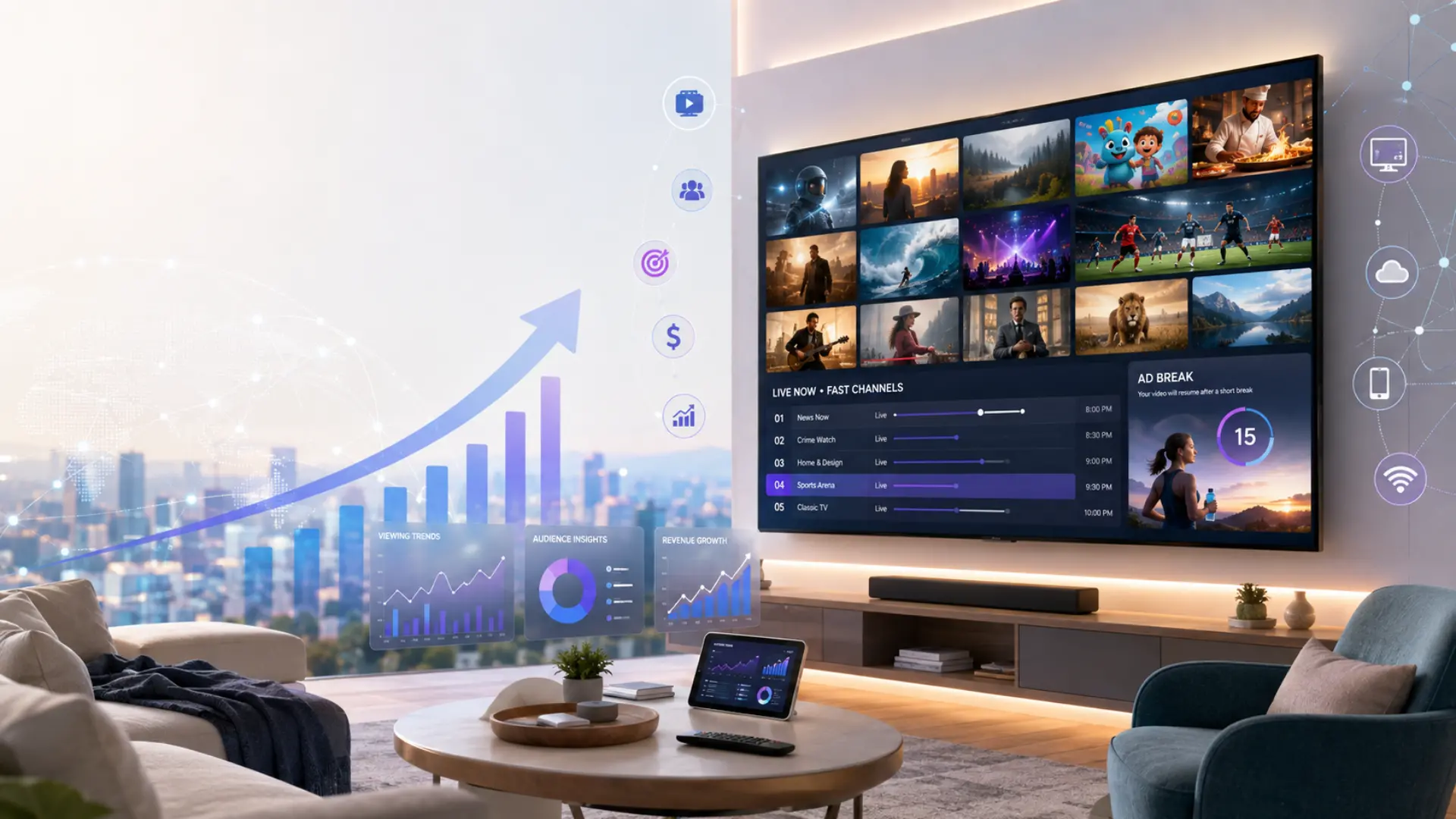
FAST channels may eventually become one of the most interesting environments for shoppable television.
FAST already combines several characteristics advertisers want:
- large amounts of viewing,
- advertising-supported economics,
- long viewing sessions,
- genre-specific audiences,
- and traditional linear-style programming.
- But FAST advertising still frequently operates much like traditional television advertising.
- Adding commerce changes that.
- A cooking FAST channel could dynamically surface kitchen products.
- An automotive channel could provide dealer information or vehicle offers.
- A travel channel could connect programming to booking offers.
- A sports channel could promote merchandise or event tickets.
- A home-improvement channel could connect products appearing in programming with retail partners.
- A fashion or lifestyle channel could create an entire commerce layer around the content itself.
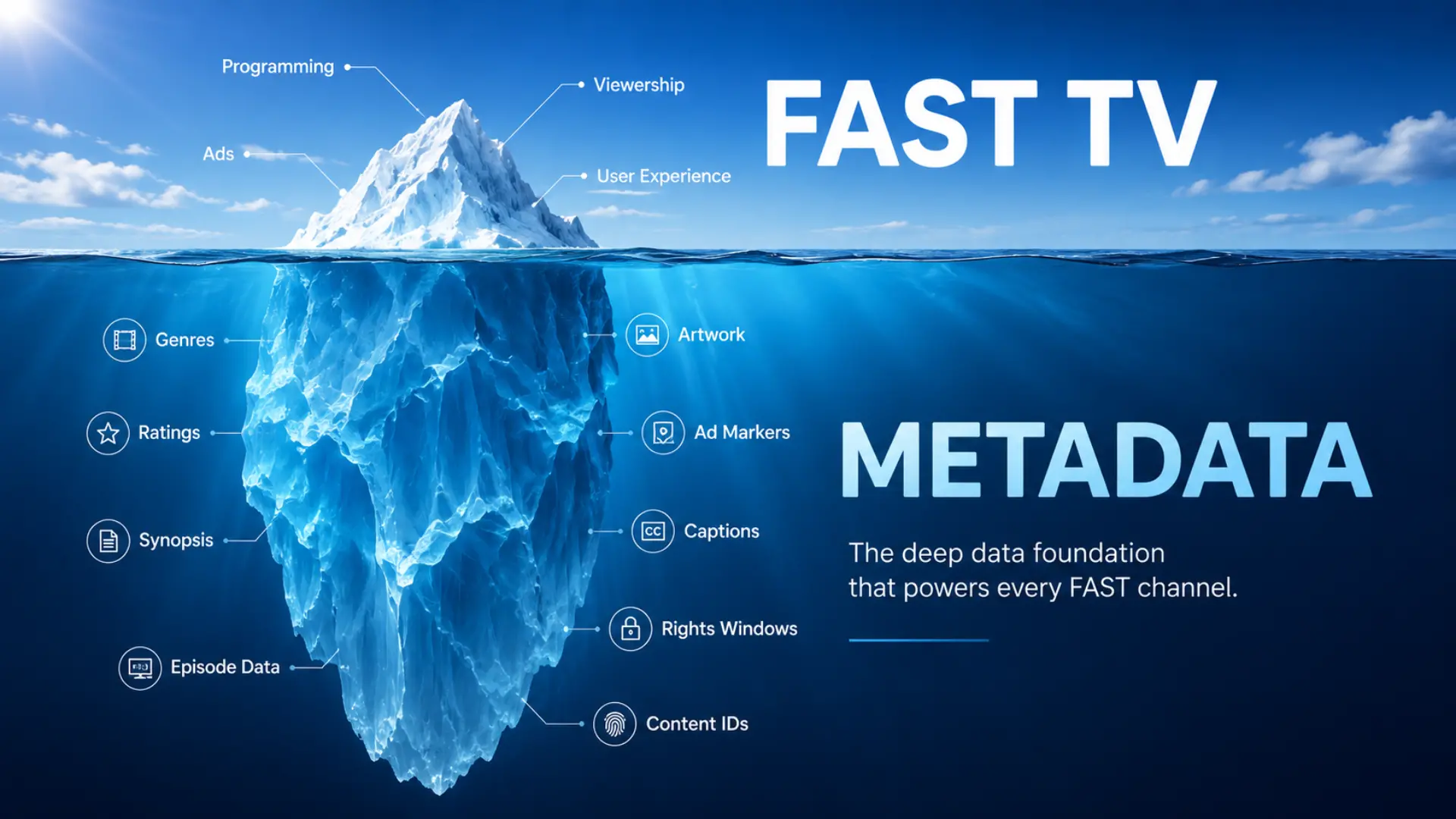
The most valuable metadata may therefore eventually extend beyond title, genre and cast to include commercially identifiable objects and products inside the video.
That is where AI video analysis and shoppable television begin to converge.
The Bigger Picture
Shoppable CTV is not simply another advertising format.
It represents a larger transformation in television economics.
Traditional television monetized attention.
Digital advertising monetized intent.
Retail media monetized purchase behavior.
Shoppable streaming is beginning to combine all three.
The companies with the strongest positions are those able to connect the entire chain:
viewer → content → advertisement → interaction → product → purchase → attribution.
Amazon has perhaps the strongest commerce engine.
Roku has built one of the best native television transaction flows.
Samsung has extraordinary control over the television environment.
Walmart and VIZIO combine retail data with TV distribution.
YouTube brings enormous reach and Google's advertising infrastructure.
Disney and NBCUniversal understand how to make content itself commercially actionable.
BrightLine, Innovid and KERV are helping make those experiences portable and scalable.
The ultimate winner, however, may not be a single company.
It may be an interoperable ecosystem in which a viewer can interact with any relevant advertisement or product on any streaming service, send it to the commerce provider they prefer and complete the transaction with almost no friction.
At that point, the phrase “television advertising” will no longer adequately describe what is happening.
Television will have become a commerce platform.