What Is FAST Channel Backfill Content?
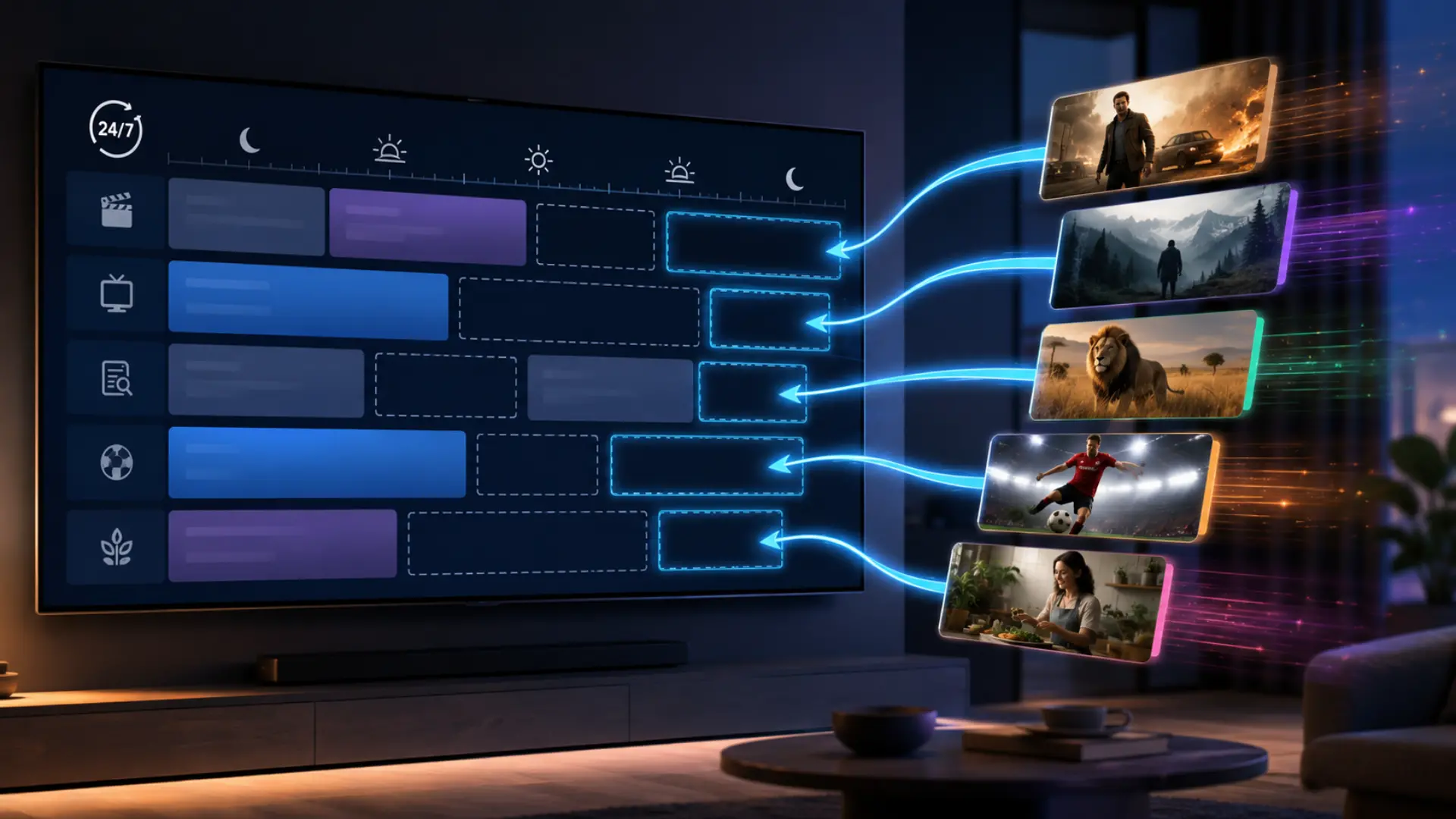
FAST channel backfill content is supplemental programming used to fill gaps in a Free Ad-Supported Streaming TV channel’s 24/7 schedule. It is the “extra inventory” of movies, series, documentaries, specials, short-form programming, live-event replays, or evergreen episodes that a FAST channel licenses or inserts when its primary programming library is not large enough, fresh enough, or available enough to keep the channel running smoothly.
In practical terms, backfill content helps a FAST channel avoid dead air, excessive repeats, thin schedules, stale programming blocks, and poor viewer retention. It gives channel operators more flexibility, more variety, and more monetizable viewing hours without requiring them to own or produce every piece of content themselves.
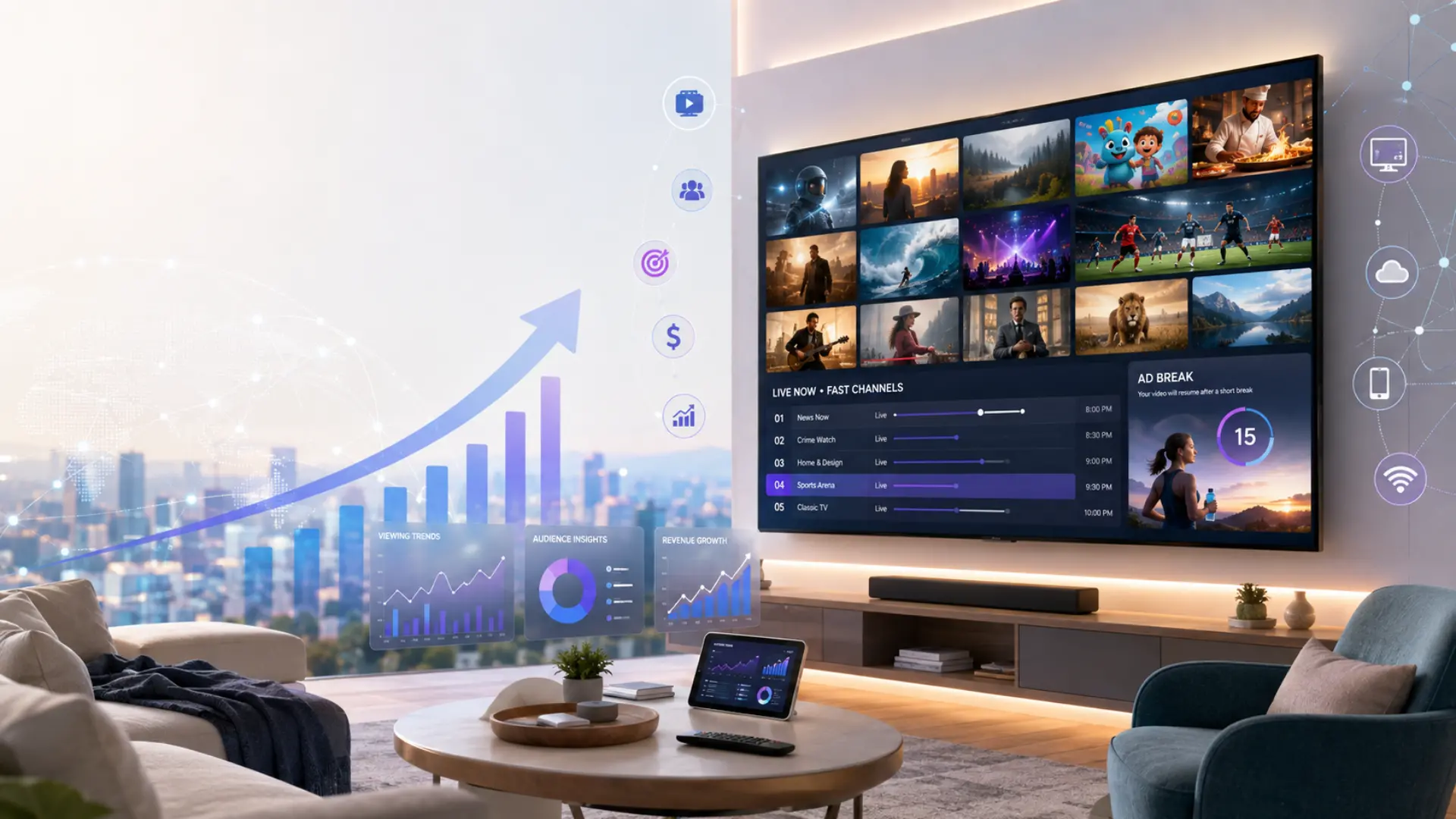
FAST stands for Free Ad-Supported Streaming Television. FAST services deliver free, ad-supported video to viewers, often in linear, scheduled channels that resemble cable TV but stream through connected TVs, smart TV platforms, mobile apps, and web players. Major FAST ecosystems include services such as Pluto TV, The Roku Channel, Samsung TV Plus, Tubi, Xumo, Plex, and others. The category has grown rapidly as viewers look for free alternatives to subscription fatigue and as platforms seek scalable ad-supported viewing inventory. FAST channels are generally linear and schedule-based, while AVOD is usually on-demand, though many modern services now blend both formats. (Wikipedia)
Why Backfill Content Matters
A FAST channel is usually expected to run all day, every day. That creates a major programming challenge. A single channel needs hundreds or even thousands of hours of usable content to feel fresh over time.
A traditional TV network can rely on a deep catalog, live programming, originals, reruns, syndication deals, and carefully planned dayparts. A FAST channel often has fewer resources. Many channels are built around a genre, a brand, a niche audience, a personality, a franchise, or a content owner’s existing library. If that library is too shallow, the channel becomes repetitive quickly.
Backfill content solves this problem by adding licensed third-party programming that complements the channel’s core identity.
For example:
A true-crime FAST channel may have a strong anchor series but not enough episodes to run continuously without repeating too often. It can use backfill documentaries, investigation specials, court shows, or related crime programming.
A travel channel may have a few premium destination series but need additional food, culture, adventure, and lifestyle content to round out the schedule.
A sports-adjacent channel may have occasional live events but need classic matches, athlete profiles, training shows, documentaries, talk shows, or highlight packages between live windows.
A comedy channel may use licensed stand-up specials, sitcom episodes, sketch shows, interviews, and festival programming to support its core lineup.
Backfill is not necessarily “filler” in a low-value sense. Good backfill can increase watch time, improve ad opportunities, reduce churn, support better scheduling, and make a channel feel more complete.
A Simple Definition
FAST channel backfill content is licensed supplemental content used to complete, refresh, or extend the programming schedule of a free ad-supported linear streaming channel.
It is especially useful when a channel needs:
- More hours of programming.
- Fresh content rotation.
- Genre-compatible shows or movies.
- Replacement content when rights expire.
- Seasonal or thematic programming blocks.
- Content for low-demand dayparts.
- Additional ad-supported monetization inventory.
- A bridge between live events, premieres, or tentpole programming.
How FAST Channel Scheduling Works
Unlike YouTube or a pure AVOD catalog, a FAST channel usually presents programming in a continuous stream. Viewers tune in to whatever is playing at that moment. This creates a “lean-back” experience similar to traditional cable.
A typical FAST channel schedule might include:
- Morning blocks.
- Afternoon repeat-friendly programming.
- Prime-time anchors.
- Weekend marathons.
- Seasonal stunts.
- Live or pseudo-live events.
- Overnight programming.
- Interstitials, promos, bumpers, and ads.
Because the channel runs continuously, the operator must program 168 hours every week. Even if some shows repeat, the schedule still needs enough variety to avoid audience fatigue.
Backfill content gives programmers a larger pool of titles to build rotations, test performance, fill low-value slots, and improve the channel’s overall flow.
Backfill Content vs. Core Content
It is helpful to distinguish between core content and backfill content.
Core content is the programming that defines the channel. It may be owned by the channel operator, exclusively licensed, strongly branded, or used as the main reason viewers come to the channel.
Backfill content supports the channel. It may not be the headline attraction, but it keeps the schedule active, coherent, and monetizable.
For example, a channel called “Classic Action Heroes” might use a recognizable action series as its core content. Backfill could include lower-cost action films, martial arts movies, behind-the-scenes specials, stunt documentaries, or international action programming. The backfill reinforces the channel promise without necessarily being the primary draw.
The best backfill is not random. It should match the audience, tone, genre, rights requirements, technical standards, and monetization goals of the channel.
Common Types of FAST Backfill Content
Backfill content can take many forms. The most common categories include:
Evergreen series
Shows that do not age quickly are especially valuable. Lifestyle, cooking, travel, documentary, factual entertainment, home renovation, crime, paranormal, and reality programming often work well.
Movies
Films are useful because they fill long blocks and can be scheduled by genre, theme, actor, season, or audience profile. Movie channels were among the largest genre categories in FAST market analyses, and film libraries remain important to the ecosystem. (Mordor Intelligence)
Documentaries
Documentary content is effective for factual, history, science, nature, biography, crime, culture, sports, and current-affairs channels.
Live-event replays
A live event can be valuable once, but its replay window can also provide additional monetization. Sports, concerts, festivals, combat sports, esports, conferences, and cultural events can often be repackaged after the live window.
Short-form programming
Shorter segments can help fill gaps between longer shows or create flexible programming blocks. These may include interviews, behind-the-scenes clips, mini-docs, recipe segments, travel tips, or highlights.
Seasonal content
Holiday movies, Halloween specials, summer travel shows, food programming, sports previews, awards-season coverage, and other seasonal assets can refresh a channel without changing its identity.
Library TV
Older shows that may not command premium SVOD licensing fees can still perform well in ad-supported environments, especially if they are familiar, bingeable, or genre-specific.
International content
Foreign-language or dubbed content can be useful for niche channels, multicultural audiences, or platforms with international reach.
Why FAST Channels Need So Much Content
FAST channels need volume because linear streaming creates a different consumption pattern from on-demand viewing.
A viewer may tune in for ten minutes, leave, and return later. Another viewer may keep a channel on in the background for hours. A third may discover a channel during a platform browse session. In each case, the channel needs to feel alive and varied.
A 24-hour FAST channel can burn through programming quickly. Even a 100-episode series may not be enough if the same episodes repeat too frequently. Wikipedia’s FAST overview notes that while traditional broadcast syndication may work with roughly 65 to 100 episodes, a 24-hour FAST channel may require far more programming depth; it cites 500 episodes as a practical benchmark for some single-franchise FAST channels. (Wikipedia)
That is exactly where backfill content becomes important. It lets a channel operator expand beyond its owned or anchor library without rebuilding the channel from scratch.
The Business Value of Backfill Content
Backfill content can create value for both channel operators and rights holders.
For FAST channel operators, backfill content can:
- Increase total watch time.
- Reduce repetition.
- Improve schedule quality.
- Support better dayparting.
- Create more ad impressions.
- Help test new genres or audience segments.
- Replace expired or underperforming titles.
- Make a channel more attractive to platforms.
- For rights holders, backfill licensing can:
- Generate incremental revenue from underutilized libraries.
- Expose content to new audiences.
- Monetize older or niche titles.
- Create performance data for future licensing.
- Open relationships with FAST platforms and channel operators.
- Extend the life of content beyond SVOD, cable, DVD, or transactional windows.
This is particularly important for producers, distributors, and libraries that own valuable content but lack direct relationships with every FAST platform or channel operator.
How Backfill Content Is Licensed
Backfill content can be licensed under several models. The structure depends on the value of the content, the channel’s reach, the rights holder’s expectations, and the platform’s monetization model.
Common models include:
Revenue share
The rights holder receives a percentage of advertising revenue generated by the content.
Flat license fee
The channel operator pays a fixed amount for a defined term, territory, and usage window.
Minimum guarantee plus revenue share
The rights holder receives a guaranteed payment plus upside if ad revenue exceeds a threshold.
Usage-based licensing
Payment is tied to hours streamed, views, impressions, or other consumption metrics.
Barter or promotional placement
In some cases, rights holders may accept exposure, data, promotion, or platform access in exchange for lower upfront economics.
FAST platforms and channels typically need licensed rights before monetizing film or TV content, and rights holders may be compensated through flat fees or advertising revenue shares. (SymphonyAI)
Rights Issues That Matter
Backfill content is only useful if the rights are clear. FAST distribution can involve multiple rights dimensions, including:
- Territory.
- Language.
- Ad-supported streaming rights.
- Linear streaming rights.
- On-demand rights, if needed.
- Clip rights.
- Music rights.
- Talent and guild obligations.
- Exclusivity or non-exclusivity.
- Windowing restrictions.
- Platform restrictions.
- Term length.
- Reporting requirements.
Some content may be cleared for AVOD but not linear FAST. Some may be cleared for the United States but not Canada, the UK, Europe, or Latin America. Some may have music rights that limit digital distribution. Some may require special handling around sponsorships, product placement, or embedded advertising.
This is one reason FAST backfill licensing can be operationally messy. A channel operator does not just need content; it needs content that is legally usable in the right format, territory, time window, and monetization model.
Technical Requirements for FAST Backfill Content
Backfill content must also be technically ready for digital distribution. A rights holder may have great programming, but if the files, metadata, captions, and delivery materials are incomplete, the content may be difficult to use.
Common requirements include:
- Broadcast-quality video masters.
- Correct aspect ratio and resolution.
- Clean audio.
- Captions or subtitles.
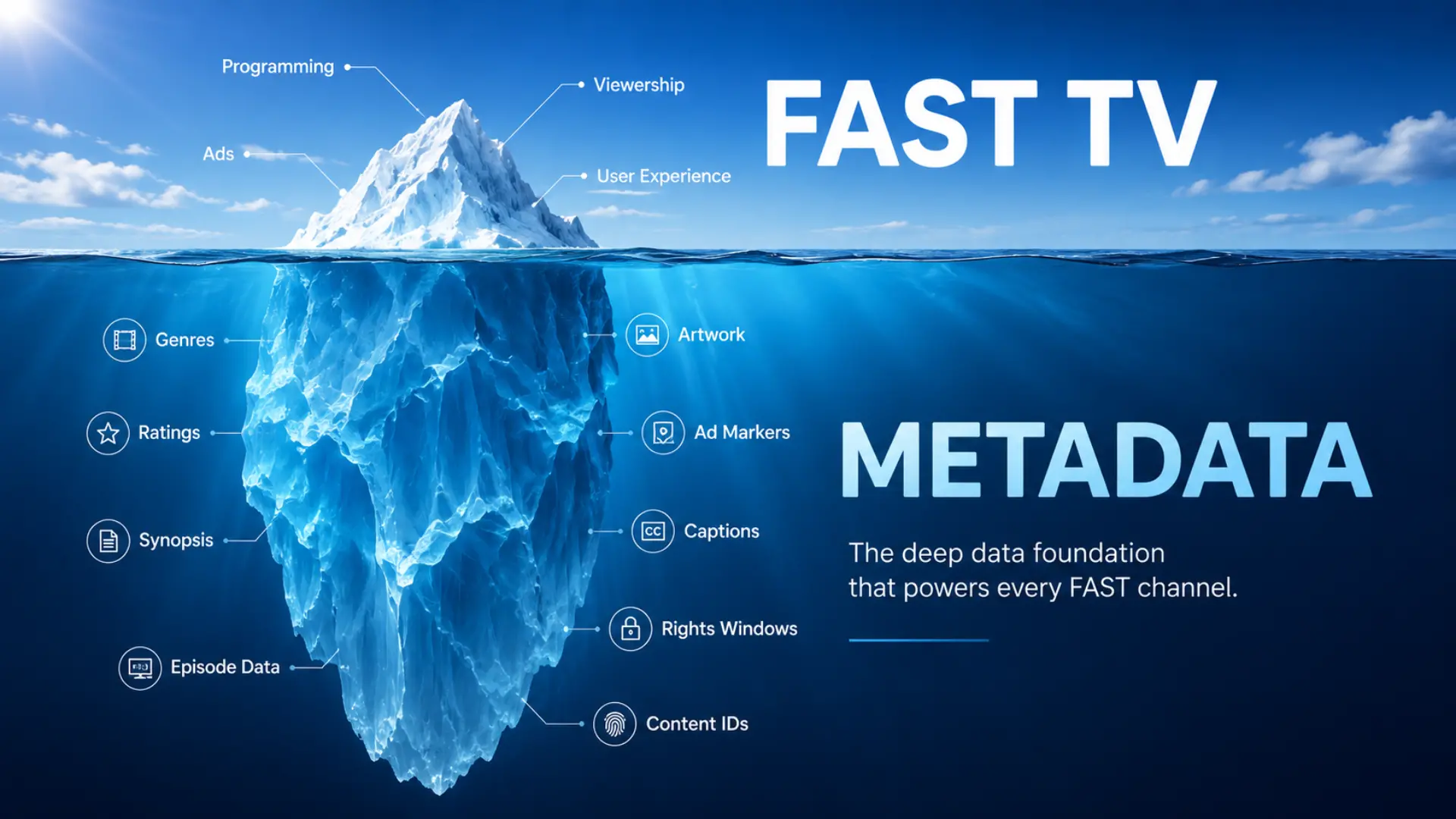
- Title-level metadata.
- Episode descriptions.
- Genre and rating information.
- Content duration.
- Ad break markers.
- Thumbnail and key art.
- Series and season structure.
- Rights metadata.
- Delivery feeds such as MRSS.
- HLS or other streaming-compatible assets.
FAST workflows often rely on structured metadata and delivery pipelines. MRSS and HLS are commonly discussed in FAST technical operations because MRSS can provide content metadata and feed structure, while HLS is commonly used for streaming delivery. (Molten Cloud)
For backfill to be useful at scale, the channel operator should be able to ingest it quickly, understand the rights, schedule it, monetize it, and report performance back to the rights holder.
What Makes Good Backfill Content?
Not all content is good backfill. The best backfill content usually has several qualities.
It is genre-compatible. A viewer watching a channel about outdoor adventure probably does not want random courtroom programming inserted into the schedule.
It is evergreen. Content that remains relevant for years is especially valuable.
It is repeatable. FAST schedules often rely on repetition, so content should tolerate multiple airings.
It has clear rights. Confusing rights slow down licensing and increase legal risk.
It is technically ready. Complete files, metadata, captions, and art make content easier to deploy.
It is ad-friendly. Content should support ad breaks without damaging the viewer experience.
It has enough volume. One or two titles may help, but meaningful backfill often requires a usable package.
It has audience fit. The content should support the channel’s promise and appeal to its target demographic.
The best backfill is not just extra content. It is programming that strengthens the channel.
Bad Backfill Can Hurt a Channel
Poorly chosen backfill can damage the viewer experience. Common mistakes include:
Using content that does not match the channel brand.
Repeating the same titles too often.
Licensing content with weak technical quality.
Scheduling long blocks that feel random.
Ignoring captions or metadata quality.
Using expired or uncleared rights.
Failing to optimize ad breaks.
Overloading the channel with low-value content just to fill hours.
FAST viewers have many alternatives. If a channel feels repetitive, sloppy, or off-brand, they can leave instantly. Backfill should make a channel feel deeper, not cheaper.
Backfill Content and Ad Monetization
Backfill content is valuable because FAST channels are monetized through advertising. More watchable hours can create more ad opportunities.
But the relationship is not simply “more content equals more revenue.” The content must actually retain viewers. Advertisers and platforms care about impressions, completion rates, audience quality, brand safety, and engagement.
Good backfill can help:
- Increase session duration.
- Reduce tune-out during weak dayparts.
- Support more consistent ad inventory.
- Provide more genre-targeted ad opportunities.
- Improve schedule flow around high-performing titles.
- Help platforms maintain a broader channel lineup.
- In many cases, backfill content is part of yield optimization. It gives programmers more options to place the right content in the right slot for the right audience.
Backfill Content vs. Filler Content
The word “backfill” can sound tactical or secondary, but it should not mean “junk content.”
Filler content is content used merely to occupy time.
Backfill content is content used strategically to support the schedule, improve viewer experience, and generate incremental revenue.
The difference is intent and quality. Strong backfill is curated, rights-cleared, technically prepared, and aligned with the channel’s programming strategy.
Why Marketplaces Are Emerging for Backfill Licensing
Historically, content licensing has been relationship-heavy and manual. Deals are often negotiated through emails, spreadsheets, screeners, file transfers, rights checks, metadata exchanges, and custom contracts.
That does not scale well for FAST backfill, where channel operators may need smaller packages of content quickly and rights holders may want to monetize large catalogs without negotiating every title one by one.
A marketplace approach can help solve this by standardizing discovery, screening, licensing terms, metadata, reporting, delivery, and invoicing.
For a FAST operator, the ideal workflow is:
- Search for content by genre, rights, territory, duration, language, and availability.
- Preview titles in a screening room.
- Review standardized terms.
- License a package quickly.
- Receive assets or an MRSS feed.
- Schedule the content.
- Track usage and performance.
- Pay through consolidated invoicing.
- For rights holders, the ideal workflow is:
- Upload or list available titles.
- Define rights and territories.
- Set pricing or revenue-share terms.
- Make content discoverable to qualified buyers.
- Deliver assets efficiently.
- Receive usage reporting.
- Get paid without managing dozens of one-off relationships.
This is exactly the kind of problem a dedicated FAST/AVOD licensing marketplace can address.
Where FurtherTV Fits
For a marketplace like FurtherTV, FAST channel backfill content is a natural wedge into the streaming ecosystem.
FAST channels need a constant supply of usable, rights-cleared, schedule-ready programming. Rights holders need better ways to monetize underused catalogs. Platforms and channel operators want less friction, fewer spreadsheets, simpler reporting, and faster delivery.
A marketplace can create value by becoming the connective layer between content supply and channel demand.
The strongest positioning is not merely “we have content.” It is:
- We make backfill content searchable.
- We make licensing terms simpler.
- We make content easier to screen.
- We make delivery faster.
- We make reporting more transparent.
- We reduce manual deal friction.
- We help FAST channels refresh their schedules and monetize more hours.
That is a more powerful proposition than a traditional content library pitch because it addresses a recurring operational pain point.
Example Use Case
Imagine a FAST channel called “Adventure Planet.” It has 300 hours of owned outdoor and travel programming. That sounds like a lot, but for a 24/7 channel, it can become repetitive quickly.
The channel needs:
- More mountain sports content.
- Some survival documentaries.
- Travel-food programming for weekends.
- Short-form destination segments.
- A few seasonal specials.
- Maybe some live-event replays from adventure races.
Instead of negotiating with ten distributors manually, the programmer uses a marketplace to find 150 additional hours of compatible content. The programmer filters by U.S. FAST rights, English language, HD availability, captions, 12-month term, revenue-share model, and MRSS delivery.
The channel now has a deeper schedule, fewer repeats, and more advertising inventory. The rights holders earn incremental revenue. The viewer gets a better channel.
That is FAST backfill content working properly.
The Future of FAST Backfill
The FAST market is still evolving. Growth in connected TV, smart TV operating systems, ad-supported tiers, and free streaming bundles continues to create demand for content. EMARKETER forecast that U.S. FAST users would reach 131.4 million in 2026, representing 54% of connected TV users. (EMARKETER)
As the market matures, backfill content will likely become more sophisticated. Instead of simply filling empty schedule slots, channel operators will use performance data to make smarter programming decisions.
The future may include:
- Dynamic scheduling based on viewer behavior.
- AI-assisted content matching.
- Automated rights filtering.
- Performance-based licensing.
- Real-time content availability.
- Programmatic content marketplaces.
- Better metadata normalization.
- More live-event replay packaging.
- Genre-specific backfill bundles.
- Automated reporting and revenue allocation.
Backfill will become less of an emergency fix and more of a strategic programming layer.
FAST channel backfill content is supplemental licensed programming used to fill, refresh, and strengthen the schedules of free ad-supported linear streaming channels. It helps channel operators solve one of the central problems of FAST: how to keep a 24/7 channel fresh, monetizable, and aligned with viewer expectations without owning every hour of content.
For FAST operators, backfill content provides flexibility, scale, and schedule depth. For rights holders, it creates a path to monetize libraries that might otherwise sit underused. For platforms and marketplaces, it creates an opportunity to reduce friction in content discovery, licensing, delivery, and reporting.
The key is quality and fit. Backfill should not be random filler. The best backfill is rights-cleared, technically ready, audience-aligned, and strategically scheduled.
As FAST continues to grow, backfill content will become an increasingly important part of the streaming economy — especially for channels that need affordable, flexible, high-quality programming to keep viewers watching and advertisers buying.